
|
  Does this drill look like a drill used /recommended by a player who believes in squaring the clubface early or late? Does it look like a drill used by a man who uses his right hand alot for imposing power? Maybe..but not to me...I love this drill...encourages sequenced release in my experience. |
Dariusz
We certainly have a very different perspective on golf mechanics, physics and biomechanics. You wrote-: "Do an experiment yourself - address the ball with a severely closed clubface with an attempt to hit the ball straight forward - you will see how hard (or even impossible) is to hook the ball in such a scenario. What will happen is that you subconsciousnessly hit the ball with a more open clubface that it was at address and most likely (depending on your swing characteristic) you'll obtain a fade pattern. No CP, CF or other forces will be ever able to overcome your subconsciousness." You claim, amazingly, that a golfer will likely fade a ball if he addresses the ball with a severely closed clubface, because you believe that the subconscious mind will overcome CF, or other biomechanical forces, that predispose to hitting the ball left if the clubface is severely closed at address. I personally don't believe that it will happen, and if it does happen, then the golfer has to markedly intefere with the natural release swivel action. Normally, the back of the left hand and clubface swivels 90 degrees when the club moves from the delivery position to the impact position. During this time period, the left wrist is also completely uncocking as power accumulator #2 fully releases. You are essentially recommending that a golfer's subconscious mind needs to interfere with this natural release swivel phenomenon, that is happening very fast in the late downswing, so that the golfer can prevent the closed clubface from closing too fast during the release swivel action. Phew! I have heard of recommended measures to prevent the ball going left, but this particular recommendation is far beyond the outer limits of my understanding of golf mechanics. If Hogan really harbored this belief, then I am not surprised that Hogan would have tried not to reveal this idea to anyone! I will resist the opportunity to formally request that you answer the obvious follow-up question - how does the subconscious mind get the arms/hands to interfere with the natural release swivel action in a controllable/repeatable manner. Jeff. |
Jeff, I am sorry that I constantly amaze you :)
In fact, you start to amaze me, too. First, for unknown reasons, you resist to try on yourself to check what I recommend you to do in order to verify if my feels are correct or not. FYI, the "shut face drill" is one of the best I know to learn proper pivot and proper impact position. Just try it and report back if you are able to hook the ball while trusting your subconscioussness. When you are driving a car - do you think about pressing the gas pedal, changing gears or turning steering wheel ? If you really do I guarantee that you are much worse driver than this who has his thoughts in the clouds and lets his/her subconsciusness drive the car. You also amaze me with lack of intuition. In your opinion, the natural release is a swivel action. Please spent more time with total beginners and you will learn that noone starts to hit the ball like Hogan (Cotton's push release) or Els (Cotton's crossover release), but they slap-hinge it (or, as you TGMers call it - flip), bent left wrist in urge to hit the ball in the air and chicken-winging. This is a natural way to release the club that does not mean the best. All other things (as proper pivot, flat left wrist, swivel, etc.) are educated things. And, IMHO, you do not educate your hands - you educate your subconsciousness to not interefere with a technically proper way to hit the ball since the intuitive way is not good for many objective reasons (as e.g. not believing in loft of the club or not believing in body turn or not believing in proper CoG shift, etc.) Now, imagine that everyone except Hogan did not educate their subconsciousness to not interfere with such a "strange" subject as opening/closing clubface concept is. And that is why only post-accident Hogan (not counting autistic Moe Norman) owned his swing and made it repeatable and consistent much more than everyone else did or does it. Try to look at the big picture - the best thing you can do in a golf swing is to minimize timing issues. Answer yourself what should a man equipped with main body and four distal parts (legs and arns) do in this matter. Hogan apparently succeded in minimizing timing issues in his swing - this was his key to success and I am trying to discover it by making my own mistakes and errors. The closing/squaring clubface issue is, IMHO, one of the most important, since the ball react to the contact with the clubface and what really matters is what angle the clubface is coming from, what angle does it have at contact, and at separation. Until now, nobody succeded in finding Hogan's secret(s) - and that is why there are still no golfer who can be in Hogan's league as regards accuracy, consistency and repeatability of shots. Unfortunately, Mr.Kelley (as well as other instructors, swing analysers and coaches) also apparently failed since there are no TGM students who may be compared to Hogan in this sense. Therefore, since Hogan took the majority of what he discovered to the grave, all avid Hogan fans should try to keep further in the dirt - and this is the difference between us, since you do not want to "dig in the dirt yourself" but prefer to concentrate on what is already written. What I see is that Hogan's clubface is square to the arc for a longer time than all other players I had the pleasure to analyze. It's a fact for me. Moreover, the correlation between a square-to-the-arc clubface in the whole impact zone and minimizing timing issues is so convincing, that is hard to believe it can be a better way...if you know a better way - share your thoughts and I'd be the first to follow your advices immediately. Now, I am trying all the time to learn how did he do this in the way it was almost automatic for him. That's why I am on serious golf fora, like here at Lynn's site. And, finally, this is why I am not rejecting any ideas, even those that appear to be very goofy at first sight. |
Dariusz
Because I know that you are a serious student of the golf swing, I would recommend that you stick-around, and participate, in this golf forum. You could learn a totally different way to think of the golf swing. You must get HK's TGM book and read it multiple times, and you must read all of Lynn Blake's archived posts. If you do, I suspect that you will never again state-: "And, IMHO, you do not educate your hands - you educate your subconsciousness to not interfere with a technically proper way to hit the ball." HK's "educated hands" concept is fundamental to learning the "technically proper way to hit the ball." Hitting a golf ball, like driving a car, is not an intuitive skill. It is an acquired skill that only becomes intuitive when one clearly understands how do it subconsciously. However, the golf swing must first be consciously learned, then rehearsed at a slow speed, eventually at faster speeds, while paying attention-attention-attention to the details. Eventually, with proper learning and the requisite amount of "correct" practice, it can become subconsciously efficient. If you read HK's book, then you will likely never have the need to again use Henry Cotton's terms "crossover release" and push release". HK offers a much better swing vocabulary that is more precise and more biomechanically coherent. There is an endless interest among many golfers in discovering Hogan's undiscovered "secrets". I have read a fair number of articles and books that have supposedly discovered/exposed a hidden Hogan "secret". I have never found ONE of those "secrets" to be convincingly true. I think that the great secret about Hogan's swing is divulged (within the limitations of Hogan's theoretical knowledge) by Hogan himself in his "Five lessons" book, and made much more understandable when viewed through the prism of HK's theories on golf physics/geometry/mechanics. Finally, you wrote-: "Moreover, the correlation between a square-to-the-arc clubface in the whole impact zone and minimizing timing issues is so convincing, that is hard to believe it can be a better way...if you know a better way - share your thoughts and I'd be the first to follow your advices immediately." Once you study TGM and understand that the clubhead never travels in a straight line, and that the clubface only needs to be square at the moment of ball-clubface separation (if you want to hit the ball straight), then you can start to learn how to "educate the hands" and the supporting body pivot action how best to produce a consistently reliable ball flight pattern. A good place to start learning about the TGM learning curriculum is in Lynn Blake's free video gallery - view the entire Colin Neeman and Jeff Hull series of video lessons. Jeff. |
Jeff, I am a bit disappointed with you and you lecturing tone of your last post. Is 2 months a long enough term for you to forgot how to speak with standard non-TGM language ? Is it long enough for you to change subjects the way you do and just only lecture others to study the Book ?
Do you think that I am not aware of the fact that clubhead does not travel in a straight line or that a golf swing must be conscioussly learned ? You also said you have never found any "secrets" of Hogan to be convincingly true - how can you say this if you neglect digging in the dirt yourself ? how can you say that the Yellow Book is the best way to understand what principles Hogan used to be the best ballstriker in history of the game since, as I told you, noone of TGM students could ever duplicate or be close to Hogan's overhuman accuracy and consistency ? I have been studying many theories for months and years and, frankly, noone can produce a Hogan-league ballstriker. Why ? Because noone is able until now to fully grasp and understand the whole concept how to make the swing motion almost automatic despite all well-known human body flaws. I am sure I will study The Book somewhen just for my own pleasure of being a more educated swing theorist in the future. This may be the best golf book ever written, I do not neglect this. However, as a post-accident Hogan swing analyst I need much bigger biokinetic picture than concentrating on details. I am saying this not to underrate Mr.Kelley's work - au contre, I am here to know a pure TGM version on Hogan's motion - something like Yoda said in the TGM language which I do not understand and still await his version for non-TGMers in order to check how close they are to The Secret. Lastly, do not underestimate Hogan and his theoretical knowledge - IMHO, he was a much smarter guy than many of us think and if he only wanted to reveal all what he knew in another never-written book - this would be the best golf book ever written BY FAR. Cheers |
Quote:
I have not read the book for a while but i'm sure this was a drill for beginners so i don't see how it applies to to the debate |
[quote=Dariusz J.;53691]Jeff, I am a bit disappointed with you and you lecturing tone of your last post. Is 2 months a long enough term for you to forgot how to speak with standard non-TGM language ? Is it long enough for you to change subjects the way you do and just only lecture others to study the Book ?
Dariusz You should listen to Jeff he knows everything about the golfswing and much more than a lot of respected authorities on the golf swing regardless that he can't play. Take a look and watch the great man in action on youtube :laughing9 http://www.youtube.com/watch?v=ku1L4EieJ5M |
Pistol
Your participation if anything is consistent...positions without much substance which generally gravitate to personal attacks. Can you please point us to your knowledge base so we can better appreciate your journey. :) |
Quote:
But it is a drill that teaches a correct motion, on-plane...no throw away...good enough for anyone IMO. |
Dariusz
You offer two arguments that are particularly weak, and these arguments come up all the time when people comment on Hogan's swing. You wrote-: "You also said you have never found any "secrets" of Hogan to be convincingly true - how can you say this if you neglect digging in the dirt yourself ? how can you say that the Yellow Book is the best way to understand what principles Hogan used to be the best ballstriker in history of the game since, as I told you, noone of TGM students could ever duplicate or be close to Hogan's overhuman accuracy and consistency ?" This "digging in the dirt" argument is woefuly weak because you have no idea how much time I spend "digging in the dirt" in an attempt to understand the golf swing. By the way, despite spending endless hours "digging in the dirt", I can never personally hope to become a good golfer because I have too many physical handicaps/limitations. Hogan, although an extraordinary talented golfer, was also a mortal golfer who based his swing on many golf fundamentals/principles. Those same principles are present in many other golfers' swings. They can be studied and understood by a person like HK. However, even a perfect understanding of golf swing fundamentals cannot create an "expert" golfer, like Hogan. It requires, in addition, an inherent "gift" for executing the golf swing. The same fact applies to other sports. Roger Federer may be the greatest tennis player that has ever played the game of tennis, but that doesn't mean that one cannot study and understand the tennis principles/fundamentals that form the underlying framework of his tennis skills. I have read an endless number of golf instructional books, but none of them equals the TGM book with regards to the critically important criterion of having at its "core" a fundamentally sound scientific approach. Jeff. |
Quote:
If you can't understand the geometry of what i stated in this thread regarding the topic then i can't help you.It seems so obvious to me that the positions of hogan changed dramatically over the years so WITHOUT MUCH SUBSTANCE is your opinion And i would call that a personal attack on me but no problem since my knowledge base is playing for a living and dismantling my own swing numerous times and reconstructing. Goodluck |
Quote:
Horizontal hinging and vertical hinging would only have one point where the leading edge is square to the arc through the impact period. So given your post you're implying that angled hinging has a superior accuracy and repeatability- which doesn't make sense to me. Food for thought! |
Mike
I think that you are correct to bring up the issue as to whether the clubface being square to the arc during the immediate post-impact period represents angled hinging. I would agree with you on this point. Do you also think that the clubface remains square to the clubhead arc for the entire duration of the followthrough, until the finish swivel action commences? I also presume that the timing of the beginning of the finish swivel action (and therefore the duration of the followthrough phase of the swing) varies from golfer-to-golfer. Do you think that Hogan had a followthrough phase that was shorter, or longer, than usual? Finally, Dariusz also wrote-: "Hogan delivered his clubface square already before entering the impact zone and maintained it square long after impact what is one of very suspected "culprits" of his overhuman accuracy and repeatability." That sentence implies that Hogan's clubface was square to the clubhead arc well before impact. Surely, that cannot be true with respect to TGM teaching, which implies that the clubface must be slightly open at the time of first ball contact, and square at the exact moment of ball-clubface separation for the ball to go straight? That TGM concept means that the clubface must approach the ball with an open clubface in the few inches prior to impact, and that it cannot already be square to the clubhead arc before entering the impact zone. What do you think? Finally, in terms of hitting the ball consistently/reliably straight, is there evidence that horizontal hinging is better/worse than angled hinging (ignoring the fact that horizontal hinging predisposes to a draw at the end of its straight ball flight, while angled hinging predisposes to a fade at the end of its straight ball flight)? Jeff. |
Quote:
My quick comments above- too tired to post more now. |
Quote:
I can only say one crucial thing for your consideration - as you TGMers call it - angle hinging (that means keeping the clubface square to the arc) brings more repeatability and consistency because it may eliminate (or better said, may limit) the timing issues and subdue the clubhead motion to the pivot much better. Imagine this - your body is "equipped" with four distal parts - your legs and your arms. Let's concentrate on arms now - if the arm/forearm/wrist/hand action during the short period of impact zone is independent on the body pivot it must bring timing issues into play much more. Therefore, any of players using Henry Cotton's crossover release or your TGM horizontal hinging (i.e. when the toe passes rapidly the heel at impact) must recon on a good timing much more than a golfer with a square-to-the-arc clubface in the impact zone. Cheers |
Quote:
Thus, it is not against any teaching principles (I do hope also not against TGM principles) because it would mean that such teaching principles ought to be changed as soon as possible. :) As regards your other post - my old and fat body has a lot of physical limitations as well. However, I can verify if I can be more consistant (on my level of playing) with one swing concept comparing to the other. Thus, I do not see any reasons why you should resist to dig in the real dirt, not only in the dirt from the library. :) Cheers |
Mike - thanks for replying.
Let's examine this issue of the clubface's relationship to the clubhead swingarc more closely. Here is a photo of Vijah Singh at impact. 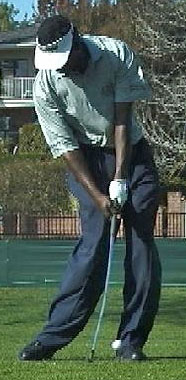 One can see that his left wrist is flat and that the back of his left hand is facing the target. Note that the clubshaft has forward shaft at lean at impact and that is has not yet reached its low point (when it should be vertical to the ground). So, the question becomes - where will the clubface, and the back of the left hand, be facing at the club's low point? I presume that you agree that a neutral grip will mean that the back of the left hand is parallel to the lower edge of the clubface (or lower clubface grooves if the lower clubface edge is rounded) - as demonstrated by Brian Manzella in this photo from an article that he wrote. 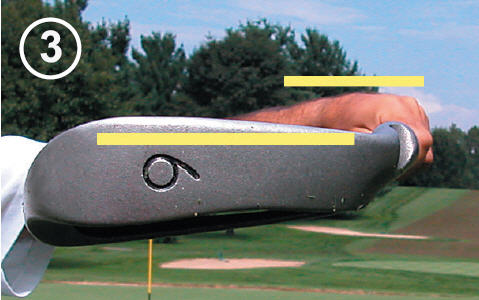 Thirdly, I will presume that you agree that all clubs have a slight degree of hookface-offset built into the club. OK. So, consider my argument. Here is a diagram showing the movement, and orientation, of the clubface through the impact zone. 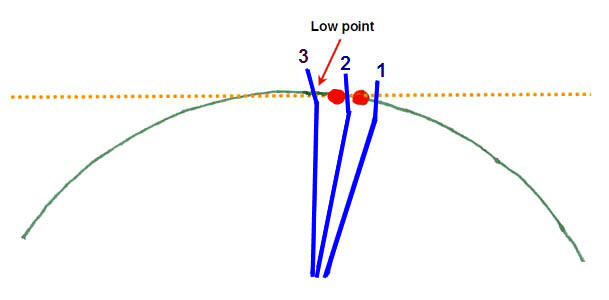 The green curved line represents the clubhead arc (as seen by a golfer - when viewed from above). The dotted orange line represents the ball-target line and the intended direction of ball flight of a straight shot. The red dot represents the ball. The blue lines represent the clubshaft and its offset hook-faced clubface. Let's presume that the low point of the clubhead arc (and therefore deepeset part of the divot) is 4" ahead of the ball position. Point 1 is a representation of the clubface approaching the ball with a slightly open clubface. At this point, there is forward clubshaft lean because the clubhead has not reached its low point, and the hosel of the clubshaft is still moving downwards and outwards and forwards. At this point. the clubface is slightly open to the ball-target line, and also minimally open to the clubhead arc of travel. Point 2 is the time-point of ball-clubface separation. If the ball remains in contact with the clubface for approximately 4/1,000th of a second, then the clubface will travel about 0.88" further (from the point of first ball contact) before ball-clubface separation happens. At this time-point, the clubface needs to be square to the ball-target line for the ball to go straight towards the target. However, the clubface will not necessarily be perfectly square to the clubhead arc at this time-point - because it presumably depends on the amount of hook-face offset built into the club. Point 3 is the low point of the clubhead arc, and it is 4" ahead of point 1 (as measured linearly along the ground). It is at this point on the clubhead arc, that the hosel of the clubshaft is going to start moving forwards, upwards and inwards. At this time point, the clubshaft must be vertical to the ground, and if it is vertical to the ground, and the club has a hook-faced offset clubface, then surely the clubface must be slightly closed to the clubhead arc at this time-point. That also means that the back of the left hand must be facing slightly left of the target at the low point of the clubhead arc (if it was facing the target at impact). After point 3 (during the followthrough phase of the swing), the clubface will surely become even more closed to the clubhead arc, and the back of the left hand will face even more leftwards relative to the target) if the golfer is using horizontal hinging, and not closed to the clubhead arc if the golfer deliberately uses angled hinging. Finally, regarding the "fact" that horizontal hinging predisposes to a straight ball flight with a tendency to fall to the left at the end of its ball flight - I got that perception from Tom Tomasello's swing video lessons in the gallery. He demonstrated that the ball tends to roll to the left after landing when using horizontal hinging, while the ball tends to roll to the right when using angled hinging. I have presumed that the end of the ball flight is not straight (even if the clubface is square to the target at the time of ball-clubface separation) due to draw spin imparted by horizontal hinging, and slice spin imparted by angled hinging. Am I wrong? Dariusz You wrote-: "angle hinging (that means keeping the clubface square to the arc) brings more repeatability and consistency because it may eliminate (or better said, may limit) the timing issues and subdue the clubhead motion to the pivot much better." First of all, angled hinging only keeps the clubface square to the clubhead arc after impact, and not pre-impact (during the release swivel phase of the swing). Secondly, from a swinger's perspective, horizontal hinging can be perceived to be the more natural hinging action, while angled hinging requires an additional deliberate effort (to keep the clubface square to the inclined plane and clubhead arc) during the followthrough. Therefore, I could imagine a person rationally arguing that a horizontal hinging action will be a more consistent/reliable hinging action for a swinger (while angled hinging is more natural for a hitter). You also wrote-: "I am surprised you thought that square-to-the arc means a square to the target line position at impact." I didn't make that mistake! See my post to Mike above. Finally, although I enjoy "digging dirt" in the library, I also go to my local golf practice facility 2-3x per week for 3-4 hour sessions of "digging in the dirt" Hogan-style. Jeff. |
Quote:
OK, I am not familiar with TGM language that much and if angled hinging means a square-to-the-arc clubface ONLY after impact, it's not the same as the concept of having the clubface square during the whole impact zone (i.e. pre-impact part as well). However, I have a feeling (please correct me if I am wrong) that a person who tends to use angled hinging post-impact, must square the clubhead earlier before impact as well. Common sense tells us so. Ah, one more thing - for a slight moment in time, do not think in swingers/hitters category and admit what scenario minimizes timing issues more. :) BTW, why do you think that all clubs have so strong offset clubfaces ? Remember that Hogan's clubs not only were with zero offset but also bent open a few degrees. Consider the same diagramme without offset factor and you'll see the difference. Moreover, in a perfect scenario of a rotary swing motion in-to-in, the divot will be slightly curving left, showing exactly the way the swing arc is going, not because the clubhead is already closed or in a process of closing, but just because it remains square-to-the-arc. Cheers |
Jeff,
I agreed with all your points except for these: 1) You could call that grip neutral if you want- I'd just call it bad. But certainly assuming one used it- then yes at low point it would be facing left. 2) Horizontal hinging does not have a draw bias. You can slice, fade, draw, hook using horizontal hinging as it really depends on the clubface relationship to clubhead path. |
Mike
I am curious. Why is that grip bad? You also wrote-: "Horizontal hinging does not have a draw bias. You can slice, fade, draw, hook using horizontal hinging as it really depends on the clubface relationship to clubhead path." I cannot understand this point. Why would one use horizontal hinging if one deliberately wanted to fade/slice the ball? Secondly, consider a golfer who wants to hit the ball as straight as possible. I presume that you agree that he must have a slightly open clubface at the time of first ball impact, and a square clubface at the time of ball-clubface seperation. So, what type of hinging action would result in a perfectly straight ball flight (with no tendency to fading/drawing) if the clubhead arc is perfectly symmetrical to the ball-target line and the clubface is square to the ball-target line at the exact moment of ball-clubface separation? Dariusz I have attempted the Tomasello "right arm throw" action on many occasions. I have found that it only works well when I use an "arm swing" style rather than a "body-swing" style, where the rotating torso drives the swing ala Hogan. Any attempt to blend the two (swinger's "pull" action secondary to a downswing pivot action powering/releasing power accumulators #4 and #2 and a hitter's "push" action due to an active right arm throw action powering/releasing power accumulators #4 and #2) results in switting, which is very problematic in terms of generating a smoothly executed clubhead swing path. You also wrote-: "However, I have a feeling (please correct me if I am wrong) that a person who tends to use angled hinging post-impact, must square the clubhead earlier before impact as well." I don't exactly know what you mean by squaring the clubface earlier by impact? Are you referring to squaring it to the ball-target line or to the clubhead arc? Either way, I think that the clubface should never be squared before impact, and the clubface must always be slightly open to the ball-target line and the clubhead arc in the few inches before the clubface impacts the ball - whether using angled hinging or horizontal hinging. By the way, I realise that all clubs have variable degrees of offset, but I have never seen a zero-offset club that didn't have a hook-face relationship between the clubface and the clubshaft. Are you claiming that Hogan's club's clubface was not hook-faced relative to the clubshaft - even if they had zero offset? Do you have a photo of Hogan's clubs? Finally, I agree that the divot should always be going left after the low point of the clubhead arc - because it reflects the clubhead arc/path that moves inside, upwards, forwards after the low point. However, the clubface has a variable degree of rotation relative to the clubhead's arc during that part of the followthrough (after the low point), depending on whether the golfer uses angled versus horizontal hinging. The first part of the divot reflects the clubhead's movement outwards, downwards and forwards prior to it reaching the low point of its arc, and that part of the divot must be directed minimally right of the target. Jeff. |
Quote:
|
Quote:
I am curious. Why is that grip bad? Obvsiously, you can integrate a movement with any grip. Is it a grip that someone could play well with? - sure. That said- here is my perspective. To call that grip neutral is a crime really. Historically and even in the Golfing Machine book- that grip is a weak grip- the left thumb is on top of the shaft and not more behind the shaft at impact. There is a reason that historically those terms were used - i.e. strong and weak - in relation to different grips. Weak isn't good. For golfing machine fanatics that would want to grip the club with the left hand flat, level and vertical- that grip doesn't accomplish that for a normal straight shot with the ball separating at or before lowpoint. That's my viewpoint. You also wrote-: "Horizontal hinging does not have a draw bias. You can slice, fade, draw, hook using horizontal hinging as it really depends on the clubface relationship to clubhead path." I cannot understand this point. Why would one use horizontal hinging if one deliberately wanted to fade/slice the ball? In golfing machine terms- horizontal hinging is the result of a golf swing that uses centrifugal force- that's what creates that amount and type of clubface closing through impact. Since golf swings that use centrifugal force- are no different than other golf swings - they all encounter on course conditions that require fading or drawing the golf ball at times. Therefore alterations are made to the impact conditions that create fading and drawing - while the motion the face makes through impact is still horizontal hinging created by centrifugal force. At least that would be "your" golf machine answer in a nutshell. |
The left thumb is slightly to the right of center in that photo. It is not a weak grip. You can read the original article if you want.
http://homepage.mac.com/brianmanzell...ellasept03.pdf I can readily accept the idea that horizontal hinging occurs naturally when a golf club releases naturally in a swinger's action. However, you didn't answer my two questions. i) Why would a swinger employ horizontal, rather than angled hinging, if he wants to fade/slice the ball? 11) What type of hinging action will result in a perfectly straight ball flight if the clubhead arc is perfectly symmetrical to the ball-target line and the clubface is square to the ball-target line at the exact moment of ball-clubface separation? Jeff. |
Quote:
I don't have the energy lately to post in detail on a lot of these subjects. You are usually pretty thorough about analyzing golf data. In regards to the photo above- the two yellow lines are parallel to each other - but do you really think that each one represents what it is suppose to represent? I see the leading edge or the equivalent score lines as not lining up with the yellow line. Also, likewise I don't see the yellow line representing the true angle of the left arm? Just camera angles etc. - obviously if someone wants to grip the way he describes it they certainly could. Regardless of all the details - that is a really weak grip. It appears that Brian Manzella via reading the linked article that you provided has derived that grip by associating it with Arnold Palmer, Tiger Woods, Sam Snead etc. and he has made that determination by noting that at the top of their swings the left wrist matches the angle of the leading edge of the clubface. All I can think of - there must be some poor measurements that were taken to come to that conclusion. To think that Sam Snead and Arnold Palmer had a flat left wrist and leading edge of the clubface that faced the target only at lowpoint- :confused1 you're kidding me right? Arnold Palmer!? YOU'RE KIDDING ME right?:scratch: |
As with most Hogan threads, it is interesting.
As for the '3 right hands', I would suggest that some who are trying to understand this concept, at least as I think I understand it, read John Schlee's "Maximum Golf" and Tom Bertrand's "The Secret of Hogan's Swing". Add the original Hogan's book and VJ Trolio's "The Final Missing Piece of Ben Hogan's Secret Puzzle". Leadbetter's book is good for pics as is the DVD series Hogan Collection and one other. But at least for me most of the questions, debated topics can be answered with those 4 books. Why Hogan had the weakened grip and how he managed to square the clubface with it, the reason for the arms close together, and why he stated others should not use his pictures to learn the golf swing but rather the book. (Thus the reason the still pics and diagram don't always track with his real life motion, cause he had to make adjustments cause of his accident). |
Very nice post Martee. Said from the heart with knowledge
study and understanding. All the best, Donn |
Quote:
Lynn, sorry for bringing this thread from the basement - but it cannot be regarded as complete without your non-TGM translation that your promised :) Cheers |
I'm glad you did bring it back up Dariusz J. There's a lot of interesting argument.
Jeff started by saying that Hogan's lower body created the flattening of the left wrist at the start of the downswing. I think John Schlee said that this was a key move for Hogan. Only it was not produced by the lower body but rather by consciously sensing the right thumb and forefinger both fall down, and in, at the start of the downswing. If the arms don't drop I believe this will both flatten the left wrist and lessen the amount of wrist cock he would be playing with through the ball. It gives the appearance of being laid off but not in a bad way I don't think. Would this increase his lag pressure? He may have been using both inertia and gravity. It may also explain part of the downcocking appearance he gives through the ball. This move is clearly evident in that famous sequence from Andrisani's book. I find it very interesting that in Modern Fundamentals he says that the right thumb and forefinger are not to be used but then qualifies this warning by saying that they may be used for finesse shots for the better player. I always thought this was referring to the short game and wedge shots but perhaps not.:idea1: |
Quote:
lower body motion would not make that happen...gravity and a heavy club could but hogan probably was a bit smarter than "hoping for the best" |
A few thoughts on some of the posts...
As far as the 'flattening' of the shaft during startdown (Sergio/Hogan) "When in doubt TURN the clubface at startdown" (I don't have the book with me for the exact location) To my eye, Hogan 'Turned' slightly at startdown, so he could 'Roll' at release, giving the appearance of a falling/flattening shaft, and maintaining his left arm flying wedge. For 'weak' vs 'strong' - keep in mind that the left hand grip, within a range, doesn't really matter in producing a horizontal hinge - it is the left arm flying wedge that matters. The left arm wedge alignments can be maintained with both a so called 'weak' or 'strong' left hand, with the appropriate compensations in the rest of the machine. |
| All times are GMT -4. The time now is 03:46 AM. |