
|
Quote:
probably... |
Quote:
Edit: ok.. Are you trying to say sequential and overlapping release of accumulator?.. Standard vs single wrist action. |
Quote:
I have always understood sequenced release to be clubface open(turned to plane) at top/end....and remains the same degree of "open/turned to plane" until release point when it uncocks . After uncocking it then rolls towards square. I have suggested that one (?only) way to maintain a geometrically flat left wrist and a square plane line requires that there is some clubface rolling BEFORE the uncocking. When you do the exercise that Bucket has written about where you practise hammering in a vertical plane....stand upright, left arm outstretched, left wrist cocked...now raise and lower left arm in front of you....you can feel accumulator 2 release...you can really hammer the ground. In this scenario, the left shoulder is in the same plane as the left wrist cock/uncock motion. Do the same motion but on an inclined plane with the same wrist condition...you get the feel of acc.2 release and then acc 3. release...a sequenced release.... all fine in the limited scenarios - it gives a very useful feel of sequenced release... but the planeline or the wrist condition or the sequence must be different in a golf swing because, unlike in these exercises, the left arm is not on the same plane as the pp3/sweetspot . That is where I am stuck...it is different to what I used to think after 2 years, 5 editions read and many hours on a variety of TGM related websites...but I cannot square the circle any more and hence the thread...I may have some incorrect assumptions along the way...if so then kindly point them out...thanks. |
I see ..
Do you understand about the geometrically flat left wrist? "flat" left wrist means the arm and clubshaft is In line if seen from the front at impact fix and it serves as a guidance. Irregardless on how bent the wrist is . and how big the Accumulator 3 is. MOST of the time, with a 30* pre-rolled strong grip , ie even 10-2-B , and a Mechanically flat left wrist, the arm and clubshaft never see the inline condition , ie hand too ahead of the club..and club is too delofted. Thus it becomes a geometrically " ARCHED " left wrist. I think at 10-2-B , the wrist should be slightly mechanically bent to reach Inline condition.. at impact. The Only time the wrist should be mechanically flat should be when the left hand grip is wrist exactly at around "vertical" and the left thumb barely on the Aft side. This is also the point where the Accumulator 3 is least with a grip under heel type of condition. ie high hands location. the confusions of the bend , flat , arched... I used to see "Flat" left wrist vs Plane as 2D plane instead of 3 D plane .. the arm and Extensor is pointing straight downward.. and wrist is cocking straight outward and downward on plane to maintain this angle of Plane Vs Arm straight down or slightly outward, Not sure if that helps. |
Mike O
When I use the term upcocking, I am only referring to the process of radial deviation of the wrist. It has nothing to do with the "backswing" per se. I should just stick to HK's use of the term "cocking" and stop using the generic term "upcocking". I cannot really understand the "issue" that Golfbulldog is exploring. He seems to be exploring the relationship of the left wrist cock action relative to a single linear plane (like a glass pane which is only generally representative of the clubshaft plane in the downswing). I believe that the left wrist cock action can only be perfectly in plane with that glass pane (in a linear sense) at a single moment in time - when the curved path of the left wrist cocking action (left arm flying wedge action) is exactly on that glass pane and parallel to that glass pane "somewhere" in mid-downswing. That "somewhere" point primarily depends on the rate of rotation of the left arm flying wedge during the downswing relative to the degree of dropping of the hands down to the ground in each individual golfer. The point that I was making about the curved left wrist cocking plane and its relationship to the clubshaft only has relevance to the intrinsic relationships within the left arm flying wedge unit - when the clubshaft is at right angles to the left arm unit, and the left wrist is always flat, then the clubshaft must always travel in the same curved plane as the left arm. This "curved-on plane" inter-relationship between the left arm and clubshaft must change dramatically during a swivel action when forearm action causes the flat left wrist/hand unit to supinate (close) relative to the overall left arm/hand movement arc. Here is an example. 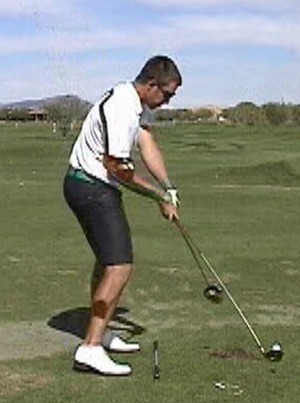 This series of images represents the release swivel action. The clubshaft is swinging down the inclined plane, but the left wrist uncocking planar action is totally unrelated to that inclined plane - because the entire flat left wrist-hand unit is swiveling counterclockwise during this time period. The general point that I am attempting to make is that relating the i) plane of left wrist uncocking action to ii) a single inclined clubshaft plane (generally represented by a glass pane placed on the ball-target line baseline and inclined at a certain angle) is meaningless, because it depends on iii) the degree of rotation of the left arm and iv) the degree of dropping of the hands per unit time during the downswing, which is individual-golfer dependent. Jeff. |
Bulldog, look at
10-3-F This term refers to any "Wrist-Action-Only" type of Stroke using Grip Type 10-2-D for Angled or Vertical Hinging and 10-2-B for Horizontal Hinging. ... take a look at the picture in that chapter.at the relationship of the arm vs plane...thats how the arm should be.vs plane.. And notice the left arm is below the right at follow through... ? It looks like a pivotless stroke.. so.. with pivot stroke its gonna be a little different look but you get the general idea how the arm vs plane works.. During dynamic motion.. it may look a winnie bit different. because of the PIVOT. CF throwout.. there is no real circle but arcs. Not forgeting how the pictures / angles/Frame FPS is taken..can be very misleading... its all in the book..and TGM RULES ! |
Thanks for your comments. I will mull this over. Busy at work this next 5 weeks so I will give the forum a break. Must concentrate on day job!
|
The On Plane Release Motion
Quote:
:salut: |
Quote:
Everything you said in your post makes sense to me. |
Homer said the closer the hands got to the ball the more VERTICAL the wrist uncocking becomes.
|
Quote:
As an analogy, think of a globe and imagine the equator and 2 circles drawn from the north and south pole whereby all intersections of these circles are at 90 degrees from each other. Both the horizontal and perpendicular circles of rotation will influence the club on a flat plane. These circles will also influence the movement of each other but not the rotational or z axis is the fixed constant around the rotation of the left wrist. To think of the 'perpendicular' (cocking and uncocking) displacement as taking place on a curved plane is incorrect unless your 'reinventing' what has been one of the most basic cornerstones of engineering and mathematical knowledge as has been practiced for the last few centuries. The displacing effect with the z-axis is somewhat more tricky to explain but not so difficult to understand once you can visualise it. When the club is directly opposed to the rotational plane it has no displacing effect other than turning it in a conical shape around the longitudinal center of gravity. When it is on the rotational plane, then it will move on a flat plane. When the club is between these alignments the club will now get displaced in a conical movement. However, the displacement of the club is still always still taking place with regards to its 2D axis. Mechanically without anatomical restraint any two of these axis can move the club anywhere around the left wrist center whereby Homer Kelley outlined the possible wrist conditions in the standard flail of 2-K... Now I cannot be bothered typing what I said before so let me just copy and paste here. ----- If the left wristcock takes place without a bent or arched condition, it moves on a plane that is aligned with the left arm. Since the left arm is not onplane and it is above plane therefore the left wristcock plane CANNOT EVER be aligned to the inclined plane. ------ However if you wish to use the sequenced release you must align the perpendicular axis to the inclined plane inorder to make it independant of the rotational axis, the horizontal axis must be employed. However simultaneous release is possible without any movement on the horizontal axis. Homer Kelley may have known this as he referenced that he believed that both swingers and hitters should use hitting alignments, and that his entire premise of clubface control was based around using two axis or rotation. I could make many arguements against this premise however mechanical advantage, and what constitutes swinging is not at the heart of this thread. As a critique of Homer Kelley, this produces many contradictions in the book where some parts are actually misleading. On the other hand, I can understand Homer Kelleys intentions for simplicity inorder to get through to those with occult idealogies as the hitting alignments Homer Kelley suggests is indeed simplier than the swinging pattern I would suggest to intellectually grasp and explain. It is a system but a system based on an adaptable 'hitting' pattern and in that respect the book is perfect. However preforming a sequenced release with a 'flat' left wrist is hogwash that needs to be throughly disposed of. |
Mathew - thanks for responding and offering a detailed explanation.
Unfortunately, I don't have the intellectual firepower to understand your explanation. I would need an even more simplified explanation, preferably with diagrams, to understand your viewpoint. I especially don't understand your statement "to think of the 'perpendicular' (cocking and uncocking) displacement as taking place on a curved plane is incorrect unless your 'reinventing' what has been one of the most basic cornerstones of engineering and mathematical knowledge as has been practiced for the last few centuries." When I state that the left wrist cocking/uncocking is occurring on a curved plane, I am referring to the sequential movement of the "left hand uncocking unit" in space over time. The left wrist has to uncock in a perpendicular plane (relative to the left arm), but if one traces the path of left wrist uncocking motions during the early/mid downswing, then the path is curved. To make my own position more understandable, I have produced this series of images.  I got these capture images from a Stuart Appleby swing video http://www.youtube.com/watch?v=_jqJ9R2LypY&NR=1 I used a spline tool to trace the butt end of the club at the left hand to trace the movement of the flat left wrist unit during the downswing. One can see that the sequential movement of the "left wrist uncocking unit" forms a curved path. One can also see that the curved left hand path intersects the inclined plane in image 5, at which time the back of the left hand is also parallel to the inclined plane and the clubshaft is on that plane - and that supports my previous post where I stated that the left wrist uncocking phenomenon occurs on a curved plane that only intersects the single inclined plane "somewhere" in the mid-downswing. You stated-: "If the left wristcock takes place without a bent or arched condition, it moves on a plane that is aligned with the left arm. Since the left arm is not onplane and it is above plane therefore the left wristcock plane CANNOT EVER be aligned to the inclined plane." I believe that image 5 disproves your theory. I believe that there is a single moment in time when the flat left wrist uncocking plane is aligned to the inclined plane, and that occurs at that exact moment in time (depicted in image 5). Jeff. |
To my mind some of the confusion around this topic relates to the perception of what the "THE" plane really is. Some see it as a single non shifting plane, the shaft plane that the club travels only below the waist. Others see it as a shifting plane of glass.
See Mathews animation 1-L-18 which shows the club traveling along the plane as it shifts up and down all the while maintaining a straight base line. Jeff your diagrams of Appleby might seem to suggest a curving path of the hands and a shaft non aligned to the plane at times. Leadbetter came to a similar conclusion I think. But what if App's plane line was drawn to show his shifts? The hands in 3-D space might still travel in a curve but the club might be seen to remain on the plane at all times with the butt pointing at the baseline. If he is on plane, that is. I believe the club may cock along this (shifting) plane as well if you cock it correctly and at the right time. Golfers with an early right hand wrist cock for instance might be cocking off plane. I saw Tiger practicing this on Saturday at the Masters. Golfers employing extensor action and a shortening side of the triangle to cock the left wrist with the bending right elbow after swiveling onto the turned shoulder plane, will to my mind, be cocking on the shifting plane. The relationship of the left wrist to the shifting plane is of interest to me. If the palm of the left wrist lays on the plane at top and the left arm is above plane the left wrist must be bent. Grip type may influence the degree of bend. Impact or follow through often sees a flat or arched left wrist. All of which leads me wonder about this threads original topic, "the plane of the left wrist cock". If it isnt in line with the left arm but on plane, I wonder about the implications to the left wrist bend. With an apparent contradiction to my, no doubt limited, understanding of the Left Arm Flying Wedge and Rhythm. Yoda? Are we correct in thinking a swinger should bend and flatten or even arch his left wrist? A use of horizontal wrist motion to align the club on plane? Or are we misunderstanding something? It may be that words fail to properly describe the topic at hand. Mathew, have you had any success trying to render this? It would be an achievement of monumental proportion if you were successful. If you have tried Im sure you have insights of interest to the forum. Any super roughs, thumbnails? O.B. |
OB Left
You wrote-: "Jeff your diagrams of Appleby might seem to suggest a curving path of the hands and a shaft non aligned to the plane at times. Leadbetter came to a similar conclusion I think. But what if App's plane line was drawn to show his shifts? The hands in 3-D space might still travel in a curve but the club might be seen to remain on the plane at all times with the butt pointing at the baseline. If he is on plane, that is." ------------------- I think that Appleby's clubshaft is always "on plane" if the peripheral end of the club always points at the baseline. However, his clubshaft is not on a single plane. It is on an near-infinite number of planes (depending on how thin you slice the planes) between the turned shoulder plane and the elbow plane during the early/mid downswing, and it is therefore continuously shifting planes. During the early downswing, the "imaginary" clubshaft plane will be steeper, and it will be less steep as the hands progressively reach waist level. A rough idea of the degree of plane shift of the clubshaft during the downswing can be obtained by tracing the clubhead path using a spline tool. The following composite photo of Aaron Baddeley's swing shows the splined path of the clubhead (roughly reflecting the angular-shifting of the clubshaft planes during the early/mid downswing) and the splined path of the flat left hand arc. The hand arc plane is steeper and I think that it can only conceived to be on the "same" plane as the clubshaft plane at a "somewhere" point in the mid-downswing. 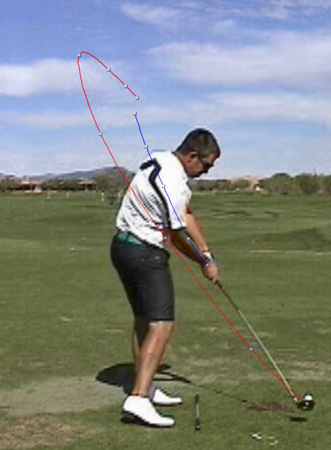 Jeff. |
Quote:
Absolutely with you on this. OB's comment is in principle the same issue that Matthew is having regarding the left wrist cocking - it's a matter of context i.e. what view or perspective you are looking at it from. For OB the understanding needs to be that you can have a curved motion of the hands and at the same time the clubshaft can maintain a straight line relationship to a straight line. In fact if you are making plange angle shifts on the downswing as viewed from down target- not sure how the hands could move anyway but curved. For Matthew the understanding needs to be that the left wrist can cock "in the plane of the left arm" and the shaft can still maintain a straight line relationship to a straight line- move on the inclined plane. Regarding single plane or shifting plane- depends on what issues you are looking at- where even if one is shifting planes as happens in any full golf stroke- anaylzing issues using the single plane concept is still a valid tool for learning the relationships of some of these items. So while you may analyze an issue using a single plane - that doesn't mean that there is a single plane- it just initially limits the variables involved. |
Quote:
Jeff Thanks. I agree with everything above accept for the word "imaginary". To my mind a golfer 's clubshaft can and should be lying flat on a plane (turned shoulder or other) in start down. A very real and ideal thing to my mind. I also believe he should be uncocking along that plane or shifting plane. If his butt end is also pointing at the plane line, I think this to be an ideal "on plane start down". Of all the above alignments the latter, plane line, might be the most important. The hands when mapped traveling through 3D space will describe a curve when viewed from down the line, agreed. Alignment golf needs straight line relationships, hence the base line , planes etc. Compliance with curves, though real they may be, is harder to do. But I could be totally wrong on all this. If I am it wont be the first time. O.B. |
OB Left
I think that we are in general agreement on this issue. You wrote-: "To my mind a golfer 's clubshaft can and should be lying flat on a plane (turned shoulder or other) in start down. A very real and ideal thing to my mind. I also believe he should be uncocking along that plane or shifting plane." I agree that it is useful to think of having the clubshaft lying on a plane during start down and also during the early/mid downswing. However, the reality is that there is no single plane that it can constantly lie on if there is a shift from the turned shoulder plane (at the end-backswing) to the elbow plane (at impact). The true reality is that the clubshaft is changing planes constantly, albeit fractionally, during its downswing passage, and that's why I used the word "imaginary". "Imaginary" doesn't imply that a plane doesn't truly exist - it implies that we are guesstimating (imagining) where the plane is at every fractional moment-of-time during the downswing. I personally don't have a problem "imagining" the clubshaft plane to be curved - and it doesn't adversely affect my conceptual ability to imagine "being "on plane". I am also aware that my hand arc movement-in-time is slightly curved as the hands move from the top of the swing to the delivery position. From my perspective, it is easier for me to think in "curves" than straight lines, because I think that the true reality is that the body, hands and clubhead always move along a curved path. However, I can also understand the concept of a straight line thrust as utilised by a hitter who applies his thrust to the club along a radial direction (like pushing on the spokes of a wagon wheel, which is stuck in the mud, in a straight line thrust diirection, to get it to start moving). Jeff. |
I'd say much of this discussion depends on the plane angle and the amount of #3 angle that is inherent in that particular plane. Release motions are a blend of #2 and #3 . . . Turned Shoulder Plane has more #2 bias and Elbow Plane has more #3 bias . . . I'm not sure that you can go to fully uncocked on the elbow plane WITHOUT A PLANE ANGLE SHIFT . . . which Homer said was "hazardous." I would say more hazardous the closer you get to the ball. So full lever extension on the elbow plane may not necessarily be fully uncocked.
Somebody said that Jackie Burke said that the only time you shouldn't switch planes on a direct flight from Baltimore to Miami. |
Jeff
Agreed. We say much the same thing. Therefor, given my track record, it occurs to me that we could both be wrong. It maybe doesnt matter how we perceive this issue about the plane as long as the butt ends of our clubs point at the base line. One mans "curved plane" is another mans shifting single plane, perhaps. I really enjoyed the 1-L-18 animation. I see a single plane with an angle that changes and a constant straight line, base line. Planes and lines to help us with our alignments. No small trick of Homers to find the correct straight lines to swing along in an otherwise circular golf swing. Many have found the wrong straight line or lines. Steering for instance. You could take a clock, with its hands unwaveringly traveling along its fixed plane face and tilt the clock from vertical to horizontal or any which way. I see the plane of the clocks face as undisturbed. No curves. I see the hands of the clock and the plane or face they travel as unchanged in terms of their relationship to each other. Mapped in 3-D space the clock hands would reflect their journey and show curves, flips, twists or whatever. This could be of great use in some manner but I think Homers planes and lines to be better for alignment purposes. At least they are for me, so far. O.B. |
Quote:
Hope Furyk reads this he could get a laugh with it. |
matthew, what book or teacher do you think best teaches the correct wrist action for a sequenced release?
|
Quote:
|
The Hammer
Quote:
I understand that the left arm is not aligned to the plane. Nevertheless, is it possible to align the left palm to the plane and effect a sequenced release? If so, does a person's Grip Type make a difference in the appearance of the Left Wrist? |
Quote:
The more the left arm is above plane - the bigger the degree of bend. The less that the left arm is above plane - the lesser the degree of bend. Quote:
The more the hand is turned the more the perpendicular motion becomes a horizontal motion. The more the hand is turned the more the horizontal motion becomes perpendicular motion. When I talk about the 3 geometrical axis of rotation and their alignments I talk about them in the terms of the underlying mechanical structure in relation to the vertical state. In the human model - the geometry remains the same no matter what the grip type may be and is just an offset which will create different actual wrist conditions based apon it. |
Quote:
|
mathew, how would you place the arms and hands at set -up?
|
Quote:
I think your not really seeing the wrist conditions properly when the dynamic nature when the roll of the no.3 accumulator comes into play. The clubs position in relation to the left arm creates the wrist conditions. It is very easy to understand these motions when dealing with 2 axis of rotation but when adding in the third it makes things more complex but not so difficult once you understand it. I am certainly not advocating a bent left wrist at impact. The wrist conditions change dynamically in accordance to where the clubhead is in relation to the left arm. The clubhead travels in a circular orbit around the left hand. The wrist conditions do not create this orbit but merely adapt around its position. And as the roll of the left hand takes place - it rotates and thus influences the two other axis of rotation. So from a turned condition where the left arm comes into the plane at an angle and the left wrist is bent inorder for the wristcock plane to be placed upon the inclined plane. Now what this allows is the fact that the release point can now be independant of the no.3 accumulator. Now with this in mind - I'll describe the - turned to the plane moving to vertical to the plane - condition of the left hand. This is 90 degrees of rotation. What was the degree of wristbend will become an equivalent degree in wristcock. What was wristcock will become an equivalent degree in arched. This of course would be in a phase of what Homer Kelley called centrifugal acceleration per 2-K. In a swingers pattern - the sequence of events occurs like this - from the top of the backstroke - The primary lever assembly has a force created against it at pp4 which when loses its acceleration starts releasing accumulator 4... whilst it is releasing, the law of the flail comes into play and the left wristcock then allows the clubhead orbit to start releasing onplane... then whilst the clubhead is motion the left wrist starts rolling and rotating the other two axis of rotation in accordance to clubheads position. Quote:
The average human is far more intelligent than most people give them credit for, but just they lack the will to actually investigate. Golf knowledge is one of my areas of expertise and I welcome questions that aren't loaded and genuinely inquiring - and time permitting, I try and answer. It should be very obvious that I have spent a great deal of time thinking and understanding and its nonsensical to those to partake in a competition with me because they have not put the energy into it that I have. It is always people that have overestimated their abilities and have a belief that they are Gods gift to instruction, however when they actually see someone with the 'real will' to learn, they feel inferior and attack rather than put that energy into their own pursuit of learning. Now I have to admit that of recent I had completely lost my ability to deal with people with the same calmness I did before for many years on similar events. However I am feeling better now and I'm getting to get into a better state of mind mainly because of some good news thats happened recently. I want to announce it just now cos very happy about it. My girlfriend and me and have decided upon getting engaged :) |
Quote:
|
Quote:
 |
Congratulations
Quote:
You have outdone yourself sir. Great catch.:clap: I'm very happy for you Mathew. Keep us posted on the future plans. :thumright |
Quote:
Shes very beautiful - but more importantly a very beautiful person inside too :) |
Congrats
Mathew
That is so cool...thank you for sharing the good news with us. I've enjoyed your posts over the years even though some of have gone right over my head. This post though may be your best.:) HG |
http://www.youtube.com/watch?v=sfT88wW2cJ0
Does Gary have a point here...maybe explained in his own terms rather than TGM. A Flat left wrist at top requires an off plane motion ? (assuming attempt at square-square set up plane line)...or, IMO, an early roll of the sweetspot off the plane? Thanks for your last post, Matthew - very clear....and congratulations! |
Quote:
If you had a flat left wrist at the top of the backstroke the release would have to be simultaneous inorder to be onplane. The rolling of the left hand has a symbiant relationship with the uncocking of the left wrist. This is precisely the difference between the vertical flail and onplane flail of 2-K. However if you are allowing the physics to work in this manner (as one of my experiments once showed me that perhaps I will reproduce for you at some point) is that the rotation happens long before the loading is completed and vise versa in the downstroke. Im not a physics genious so I create experiments to overcome my shortcomings in that department to understand a particular aspect of golfing mechanics. The simultaneous release doesn't allow this to happen in this manner and therefore is incompatible with swinging. |
Thanks to all my well wishers. :)
|
Congratulations, Mathew!
Quote:
:occasion: |
Quote:
|
Well done mathew this is awesome :occasion: you ever to come australia, my shout.
Your in Europe Burners shout :laughing9 Hey burner :salut: |
Quote:
Bio, My voice becomes a whisper when its my turn to buy a round. I was always taught that it was rude to shout! :naughty: Oh! I am a Yorkshire man also and we are not noted for flashing the cash.:laughing9 |
burner
:laughing9 , you crack me up Burner. Come to Australia and lap it up, our culture is to shout the guests:) Come and catch up oneday, then hit darty and guru up,
just remind them bio has taught you educated hands and it's the coaches job to teach you so it's there shout:laughing9 Drinking beer is a required skills to teach extensor action, applying the right hand action:laughing9 |
| All times are GMT -4. The time now is 01:20 PM. |