
|
Quote:
 YOU may like this one better though . ..  Waldorf  That's the best I can do. |
Quote:
Waldorf's attorney just called - he wants to know who you use for counsel? |
Get it?
That would be Mike O's Hudson Loafers Inc.
|
Quote:
I use numeralz for counselin' you idiot 4-1-2-3 slangin' them rockz beeeeeeeeotch!!! You probably still use fingers and toes . .. but we know you can't get to 11 with no didgets . . . maybe 10 3/4's. |
!
Quote:
|
Quote:
|
One more important consideration
After thinking on this a bit more, I realized I left out another important consideration regarding the pivot. The pivot has to interact with the ground....zone 1 is the only zone that comes in contact with the ground, and the power and speed of the pivot has to be developed from the ground up. If you try to pivot with one leg in the air, you can't go to hard or to fast...you need to be firmly connected to the ground. Also, I have found that you can generate a lot of rotational force by getting down into the ground and then rebounding up...reminds me a bit of Percy Boomer, opposing forces, gotta get down to get up.
Bucket, I would be interested to hear your thoughts on how the pivot interacts with the ground. As I understand it, the boys on the "dark side" also like the idea of getting down and springing up to generate rotational force. What have you learned about that? Also does this idea of getting down and using the ground, then springing up, fall into the sacred snare of bobbing? Did Hogan bob? Did Snead? Does it matter? Why or why not? |
Time Out
Time out a minute, gents.
Bucket, Have you decided what you wanted to know when you posted this thread titile? We are starting to discuss a lot of different elements about the pivot. How it feels to some of us, where the force originates, etc. If left unchecked, this thread may spiral out into a lot of opinions without much consensus or clarity. But I still want to know what Bucket meant by fundamental alignments of a good pivot? Then we can move forward. I think. Bucket? You have the floor. UPP in snowy Ohio |
Quote:
A. All the functions of the pivot B. The Components that make up the pivot C. Sequence of Movement in the Pivot D. Relation of Pivot to Plane Angle E. Relation of Pivot to Plane Line F. Relation of Pivot to Hand Path G. Relation of Pivot to Clubface E. Relation of Pivot do Low Point Does that get us back to the task at hand? So let's start with Function 1. Deliver the Power Package to the desired Impact Hand Location with the corresponding amount of Shaft Lean 2. Develop Angular Momentum and/or Support of Muscular Thrust 3. Allow the club to satisfy desired Plane Line/Angle requirements via the amount of Axis Tilt 4. Produce the desired Hinge Action and comply with Grip Type Requirements 5. Produce the necessary amount of Pivot Lag (for full power shots from the ground up i.e. Swinging from the Feet) Transfer momentum from "joint segments" 6. Balance the Machine 7. Have a Center that produces a consistent Low Point and Angle of Attack That's my 5 minute stab at it . . . in no particular order. |
Quote:
I see vertical forces in these pics . .. 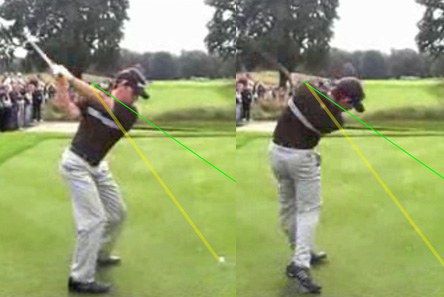 http://www.youtube.com/watch?v=PPnZE3IrHWk |
Quote:
One way to analyze the pivot summarizes the component parts as: Feet Hips Shoulders Power package Club Of course there is soft tissue and other variables in between these points but these in particular seem to be a good starting point. C. An efficient pivot occurs indeed from the groud up, with a kinetic link sequence of the segments listed in B above beginning with the ground and ending in the club compressing the ball through the impact interval. I am still not sure how you are going to tie this to alignment, though, Buck. |
Quote:
There's more to it than that . . . How is the pivot different for the elbow plane vs. the turned shoulder plane? How is it different for Angle of Approach, Plane Line Tracing, and Arc of Approach? How is it different for Line Delivery and Circle Path? I promise . . . it's different. |
Quote:
You hit the ball with clubhead, clubhead attached to shaft, shaft moved as part of power package...what starts the power package in orbit? ...the pivot...we agree on this. But can the pivot still spin the power package after accumulator 4 has started to release?? Sure , the pivot is still doing work... but is that work merely accomodating power package motion? Once you release accumulator 2... can you muscle it more to release accumulator 2 harder?? If you do try , are you more likely to upset your alignments? I think that once an accumulator has been released....further muscle power is unadvisable. And what causes release of acc. 4? I think - in a pivot stroke - it is pivot motion. In a pivot stroke, once you release accumulator 4.... can your pivot add more force? or is it just controlling direction? |
Quote:
your pivot components are whatever they have to be....for you to accomplish imperatives and essentials whilst using your consciously chosen components.... grip, plane line, plane shift, so consciously choose:- 10-1, 10-2, 10-3, 10-4, 10-5, 10-6, 10-7, 10-8, 10-9, 10-10, 10-11, 10-18, 10-19 through 10-24....leave the others to mother nature whilst you focus on steady head and imperatives...then classify 10-12 through 10-17. |
Quote:
The pivot is responsible for the GENERATION of Angular Momentum. And instrumental in determining low point and handle location. So maybe if you have too much axis tilt you have to do something compensatory via the right arm to get the handle in the right location. Let me ask you a question . . . if you release #4 and your head moves down and back is that "subtracting"? AND . . . What causes #4 angle to expand thereby expanding the rest of the accumulator angles propelling them seek their in-line relationship? |
Quote:
So you are convinced that IF I have the Imperatives and the Essentials my Pivot components will comply via mutha nature? Not sure about that one Dawgie Dawg. |
One piece at at time.....
There's more to it than that . . .
How is the pivot different for the elbow plane vs. the turned shoulder plane? This is where you can teach me something. I see only an inclined plane, not the 5 or so different inclined planes discussed at times here. Ideally (and simplistically, perhaps) the pivot would move the sweetspot on plane all the way through follow through and corresponding swivel? I want to learn more about the different planes if you think it helps this discussion. For me, 3 planes exist....horizontal, vertical, and inclined. When you start slicing and dicing the inclined plane, I start losing interest. So help me out here. UPP in snowy Ohio |
Quote:
You take the pieces you defined and talk to me about the alignments you see . . .      |
Quote:
  What is the difference between these two "inclined" planes . . . LOOK LOOK LOOK. |
What do you see when you LOOK LOOK LOOK???
http://www.youtube.com/watch?v=TiwTW...eature=related http://www.youtube.com/watch?v=FqI6IzDdpZM |
Quote:
Hands controlled pivot...pivot is controlled by the movement of the hands WITHIN the constraints provided by essentials and imperatives.... quite a pill to swallow but a sponnful of "stationary head" makes it easier to swallow...wow...I sound pretty Kool-aid preaching thinker....:eyes: :laughing9 |
Quote:
when the right shoulder motion alters/slows then the acc 4 is released.... i will pm you with special screening of a video i have....:golf: |
Quote:
back to you bucket!! todd |
Quote:
I agree that there are many variables...and the variables allow different loading and plane shifts etc...but surely the pivot components are basically meant to comply to the other bits that you can consciously control ? I think of components as being conscious(primary) subdivided into those that are -static ie. grip and plane line and can be chosen and are fixed before swing motion and - Dynamic ie. consciously controllable but occur during the swing ( and probably should be programmed during address routine...I am thinking start down waggles etc.) and unconscious (secondary)/ ie . reactive to the demands of the hands and other primary components....pivot components come into this category... obey essentials ( especially steady head and BALANCE) and they are chosen for you....in fact, I would go as far as saying that BALANCE chooses your pivot components for you... as long as you train your balance to manage the forces in G.O.L.F. and obey essentials/imperatives.... Maybe.... my interpretation of Homer... atlantic is wide and deep...things might have gotten mixed up across the ocean! Hmm...OK,may not be koolaid....maybe more like a pint of bitter...warm english beer that tastes completely different to Bud...thankfully! |
When I looked
Not sure I looked looked looked deeply enough, because I see Nicklaus as an example of an upright plane and Hogan of course as the poster child of a flatter plane. I also see the side representing Jack's ball to feet has a shorter relative dimension than than the flatter plane player would have, which makes sense. So keep going, how does this relate to different inclined planes? Don't tell me Homer labelled them according to some body feature of the player? :crybaby:
UPP in snowy and confused Ohio |
Quote:
You're sniffin' now . . . Flat vs. Upright . . .So if we drew a triangle from the hands at start down on Nicklaus vs. Hogan . . . the bottom line whatever the heck that is called would be different right? What component of the Plane (down out & forward) does that represent? |
Quote:
That line would represent the out of the three dimensions of impact. |
Quote:
So here's the $64,000 question for UppandDownn(that you, g-money, are not allowed to answer because you know it!!!) If the base of the Triangle represents the OUT . . . then how do you have to work your shoulders inorder to get the club to comply with the plane angle and amount of OUT IN THE PLANE??? ON BOTH SIDES DOWN AND THRU??? Holla back!!!! gmoney-69 . . . DON'T ANSWER THAT QUESTION OR I'LL SEND MIKE O TO YOUR HOUSE TO GIVE YOU HERPES COMPLEX 1. |
Quote:
I only answered the last one because I'm starting to get where your going. As you now know, I'm still incubating the concept. |
If the base of the Triangle represents the OUT . . . then how do you have to work your shoulders inorder to get the club to comply with the plane angle and amount of OUT IN THE PLANE??? ON BOTH SIDES DOWN AND THRU???
My guess at the money would be that the shoulders for the ball that is further from the feet would need to work more "out" and on a flatter plane. More out and less down. This may also create more axis tilt and a more "open" shoulder alignment at impact. The ball flight would tend to be a bit lower. That's my final answer.....let me know if and where I can pick up the "ka-ching" \\:D/ |
Quote:
Test your theory . . . tell us your findings. |
OK. The flatter plane reflects a longer baseline and more level shoulder movement. Conversely, the upright plane is a shorter baseline and more tilted shoulder movement. The turned shoulder plane probably lies in between these two extremes for most of us. I have that. The pivot - if a kinetically linked movement from the ground up, happens very rapidly as a stretch-shorten muscle move. Now I am stuck. What are you getting at from here, Bucks?
|
Quote:
You are on it . . . just so we make sure we got it . . . What part of the pivot makes the club go OUT? What part of the pivot makes the club go DOWN? Talk to me about the requirements for steep plane vs. flat plane. AND talk to me about how the hands have to exit to maintain the plane without a shift in the plane line. EXIT STAGE LEFT? STAGE RIGHT? OUT THRU THE EAR HOLE? NECK? SHOULDER? MID SECTION? How doe the shoulders and tilt help you with the EXIT? |
Here we go
I will stab at the answers.
What part of the pivot makes the club go down? That would be the press forward coming from the feet through the legs to the hips causing the right shoulder to drop. Note: I mean forward press in the pivot as in press and turn, not any move that starts the swing. What part of the pivot makes the club go out? That would be after the initial forward press. The turn of the left hip away from the plane line allowing the right side to move through impact with the club moving out toward the plane line prior to impact. I am not sure at all about requirements for steep vs. more flat plane, other than setup and player preference I reckon. I am guessing that the flatter plane swinger could set up with the trunk of his body more erect than the steeper plane player, but of course I see players take it back on one plane and then go straight up with the club, a la Tom Watson. Your turn, Bucks. |
Quote:
TILT = DOWN What if Nicklaus kept his right shoulder higher early in the down stroke, had less tilt, and got open quicker? What would the club do? Relate to length of the Right Triangle Base Line? Obviously Nicklaus' hands go high at the top . . . where do they go when they exit? Do his arms look "tied" or connected to his body? Now compare that to Hogan's hands at top and where the exit . .. what are the differences? |
This is AWESOME . . . watch the hand paths where the hands go when the go UP PLANE vs. where they are at delivery.
There are two really good comparisons . .. watch where Sergios hands go compared to Vijay. Watch Annika's hands they match . . . some start high exit low and left . . . some deliver low and exit high. Pretty cool video. It would be neat to be able to freeze frame these. Watch the hand paths and respective tilts/pivots . . . think about what kind of ball flight you would get with these. http://www.youtube.com/watch?v=Uevs3gAo_0M Can you save crap off of Youtube? I'd love to be able to figure out how to freeze frame these. Pay attention when Palmer pops up . . . exits low . . . hips back chest forward. Watch Sergio next . . . hips forward but exit left and low with big shift. Watch Vijay . . . High Top Drop & EXIT HIGH. |
Back to you, Bucks
TURN = OUT & FORWARD . . . (also GOING FORWARD = FORWARD and HANGING BACK = DOWN)
TILT = DOWN What if Nicklaus kept his right shoulder higher early in the down stroke, had less tilt, and got open quicker? What would the club do? Relate to length of the Right Triangle Base Line? Nicklaus swing would be shallower with those changes. The right triangle base line would be longer. I am also not sure how you monitor or control TILT other than video. The YouTube video is a good one. But after this analysis, I am still not sure what you want or mean when this post started......please lead on, Bucks. (I notice most of the usual suspects are on the sidelines in this thread. Not a good sign for yours truly.) UPP in snowy Ohio |
Quote:
If we stop Nicklaus at the Top (hands high the whole bit) . . .and say dude . . . don't tilt as much open up more . . . what does the club do? I'm not sure how to measure tilt . . . I'm just basically saying what you tell a person to do with pivot depends very much on their plane angle. So if you told Nicklaus to do the above . . . would it work? |
Once more with feeling........
Believe it or not, Bucket, I am still not seeing it.
If you hold Nicklaus' right (rear) shoulder up longer. not allowing it to go down steeply, and told him not to tilt his torso so much toward the ground, it seems to me that his swing goes out more and down not as much, hence "shallower", which is what I thought I already tried to say. Help! UPP in snowy Ohio |
Quote:
You are going to see how to stay ON THAT STEEP PLANE . . . ON PLANE Right? OK now that your hands are REALLY HIGH . . . Make a startdown by Opening your SHOULDERS . . . . ARE YOU ON PLANE? Now do the same thing and TILT EARLY . . . How did that work out? Now take your hands LOW AND DEEP like Hogan . . . Now start down by Tilting early . . . ARE YOU ON PLANE? Now Spin OPEN? How did that work? Try it for yourself. |
| All times are GMT -4. The time now is 08:08 PM. |