
|
Lynn why do you say it encourages throwaway?
Ben seems to do it fine with maximum trigger delay? Also if a student can do this "over roll" it suuuure is hard to flip it doing that type of move isn't it? |
Swivel Action And Throwaway
Quote:
The cure for each is to observe the definitive alignments: 1. Hinge Action -- The Left Wrist remains Vertical (4-C-1) to the desired Plane of Clubface Motion -- Horizontal (Closing Only), Vertical (Layback Only) or Angled (Simultaneous Close and Layback) -- from Impact to the end of the Follow-Through (Both Arms Straight position). The Right Wrist responds and also remains Vertical. 2. Swivel Action -- Then, and only then, the Left Wrist Swivels (twists counter-clockwise per 4-C-3) into its Parallel to the Plane alignment for the Finish. Again, the Right Wrist responds and also Swivels. |
the finish swivel
Lynn....thank you very much for this little gem...i have been lacking this in my swing and as soon as i incorporated this my ball striking went up another level...now it just flows start to finish:D :D :D :D delivery line roll prep ..music to my ears ...goose bumps when i hit it
|
Success With the Finish Swivel
Quote:
The Finish Swivel is so important. I've told the story before in these pages about the Finish Swivel lesson Homer Kelley once gave a student. He said he "learned more about Golf on that day than on any other." Considering the Golf water under his bridge, that's saying a lot. Later in the week we will post video where I explain and demonstrate the principles of Swivel Action and the three Hinge Actions. Stay tuned... :cool: |
divot pattern
my divots are inside to out..the in-line condition is a great feeling and a constant reminder of what it feels like...my hooked shot came from losing lag pressure...this was a part of the instruction that i didn't absorb last year during the SO Cal school but i'm sure glad i got it now..Thanks Lynn
|
The True Geometrically-Carved Divot
Quote:
Remember, you are at the bottom of a circle (Clubhead Orbit) with a radius (Left Arm and Club) some five feet in length. Accordingly, there is not a lot of 'Down' and not a lot of 'Out' left. And some of that Divot is the Club exiting the ground after Low Point and now traveling 'Up and In'. So, while the 'Outward' dimension of Impact is still present and extremely necessary to achieve, it is not enough to send the Divot out to the right. The goal is a Three-Dimensional Impact -- Downward, Outward and Forward -- and an On Line Divot. |
On Line Divots
Quote:
Or you can hang out at LBG. The choice is obvious :cool: . |
clarification
Sorry Lynn I used the wrong description...I understand the down out and through look...open to square and through,..in all my years of playing this crazy game i finally have found a gem of an instructor..thanks LYNN:smile: :smile: :smile:
|
And there it goes
Quote:
|
Quote:
Chris Note: that's assuming the kind of ground where the divot holds together, not where you just get a kind of spray of dirt! |
Quote:
I always thought the divots should point and fly to the right - so I really appreciated the post by Yoda. That is how our common sense is aometimes our worst enemy. :) |
Quote:
|
How Do You Know?
Quote:
The only reason I 'got there first' -- you would have gotten there eventually on your own -- is because in a 1982 telephone conversation with The Man... I asked about a phrase he used ("Let's all replace one geometrically carved divot...") in his June 1981 G.O.L.F. Bulletin* for Authorized Instructors. I thought that 1-L #13 and #14 meant that Divots should point to the right. But I was wrong, and he told me so. As I have told you. _________________________ * Perhaps The Golfing Machine, LLC could one day re-publish these copyrighted Bulletins, ideally for everyone, but at least for its Authorized Instructors. Homer Kelley published four -- June and September 1981 and April and December 1982. In March 1986, Sally Kelley resumed the operation and published at least four more. The last I have is dated October 1989. There may be others. |
Flying Divots
Quote:
The shorter the time the Divot stays on the Face of the Club -- or the more Inside-Out the Impact -- the more it will tend to fly to the right of Target (on the Angle of Approach). The longer the time the Divot stays on the Face -- or the less Inside-Out the Impact -- the more it will tend to exit to the left of the Target (on the Arc of Approach which may well be left of the Angle of Approach). Bottom Line: Keep your Left Wrist Flat (Left Forearm and Clubshaft In-Line / Rhythm per 2-G -- Roll, No Roll or Reverse Roll Feel) while you Trace the Straight Plane Line with your Right Forearm and #3 Pressure Point Lag Pressure. Let the Divots fall where they may. |
Divots should have 3 directions to them if you are using horizontal hinge action:
1) slightly open at begining of divot 2) goes fairly straight all the way to low point 3) begins to turn left due to the full roll and swivel However as Yoda and I have conversed about something similar before (how big your divots should be) it all depends if you TRULY stay "down" until low point. |
Quote:
....bacon strips or pork chops? |
Divot Depth -- Breakfast Or Dinner?
Quote:
|
Same?
Yoda,
If I only could copy your swing.......[-o< Do both Hitters and Swinger have the same Swivel Action? |
Swivel Action -- Hitter And Swinger
Quote:
And Swingers using Standard Wrist Action also have a Start Up (Turn) and Release (Roll) Swivel. But the Hitter avoids both, and instead uses Single Wrist Action (10-18-C #2). This keeps his right palm (and #3 Pressure Point) 'facing the Ball' as long as possible (until the natural action of the Pivot and Arm swing bring both the Left and Right palms On Plane at the Top). The Downstroke reverses this motion and brings the player into Release in position to 'slap the Ball with the palm of the Right Hand.' It is this action that causes the Simultaneous Release Motion (Uncock and Roll) of 4-D-0. |
Palms On Plane ...and smilies
Quote:
////////////////////////////////////////////////////// I just noticed there are lots of new smilies available. I'm spoilt for choice. No more excuses about not being able to express oneself. If you don't agree with someone, just use :violent: Arggh...I can't resist...so much fun. :newbie: :study: :pray: :eyes: :3gears: :iamwithst My favourite at the moment: :headbang: |
More On 'Palms On Plane'
Quote:
During the Backstroke, the Left Arm Wedge Turns (Single Wrist Action) or is Turned (Standard Wrist Action) to enable the Vertical Wristcock Motion to occur on the Inclined Plane of the Stroke. This is the 'palms parallel to the Plane' alignment necessary for the Top (8-6) and Finish (8-12) movements involving Wristcock. |
Quote:
|
Quote:
|
The Cocked Flat Left Wrist Appears Slightly 'Bent'
Quote:
Maybe what you are considering the Vertical Wristcock Motion of a Flat Left Wrist is really the Vertical Wristcock of an Arched Left Wrist (which puts the palm in line with the lower part of the Left Forearm and therefore not On Plane with the Right Shoulder). |
:BangHead:
|
Quote:
Per 2-F (caps and bold added by me) ".... the longitudinal center of gravity, the LINE OF PULL of Centrifugal Force" "Plane Angle and Plane Line always refer to the center of gravity application" What that means in effect is that you are "hugging the flail" described in 2-K, when looking at this FORCE that is moving around your center of balance. That FORCE is most clearly represented by the path of the hands, the pressure points. Learn to feel your pressure points. Learn to see the plane as the path of the pressure points around your center of balance. |
Quote:
The cocked "Flat" left wrist appears slightly bent...Preach on Preacher....That is Alignment G.O.L.F. versus Dogmatice G.O.L.F. One of the best posts in the history of LBG |
Quote:
:notworthy Very good answer. |
Quote:
|
After watching Yoda's finish swivel video, i can say that the only difference between's "ben swivel" and "yoda's swivel" is that yoda is simply swiveling it back to the plane and STOPPING and letting the left wrist bend to the finish. Where as "ben's swivel" is swiveling it as much as the face will allow which would be looking at the ground.
|
Quote:
If there is enough time and sunshine next Thursday when we play, I'll show you the One and Only Super Duper Complete Hinge Action/Motion Finish Swivel Yoda Acid Test. Just need the Sun and about four clubs laid out on precise angles. There is more to it than the pictures can illustrate. Seeing it on the ground, club in your hand (similar to Ben in the sand) uncovers the illusions. Ted took photos of the dowel layouts and he may post them on the web-site someday. |
Getting the Finish Swivel Right
Quote:
It is exceedingly important to have the correct concept in order to Translate the Mechanic into its describable Feel. And that is the main reason I produced the differentiating Hinge and Swivel Action videos put up this morning. Jim is right that I teach the Finish Swivel as advocated by Homer Kelley: 1. "After the selected Hinge Action has been executed, the Swivel is again useful for Snap Rolling the Hands into their On Plane Condition for the Finish." (2-G) 2. "But all players must Swivel -- actually rotate their Wrists -- into the "parallel to the Plane" position for the Finish after the Followthrough." (4-D-0) But he also warns: 3. "Some players even intentionally execute Impact as exclusively a Swivel, making Clubface alignments extremely fleeting and erratic." (2-G) [Bold in the above quotes by Yoda.] The first three photographs below (originally posted above by Tongzilla) illustrate an Over Swivel. Now, this particular Action may have been for a purpose or simply an error of Execution. Regardless, it is certainly something more than a Horizontal Hinge Action followed by an On Plane Swivel. In the first photo -- the end of the Follow-Through (Both Arms Straight position with the Club approximately 45 degrees to the ground) -- the toe of the Club should be pointing 'along the Line'. Instead, it is well-Closed to that alignment, far beyond the "Vertical to the ground" alignment of Horizontal Hinge Action. In the second photo, the exaggerated Closing continues. Finally, in the third photo, with the Clubshaft parallel to the ground -- and On Plane (assuming it is also parallel to the Plane Line) -- the Clubface is facing directly toward the ground (and not towards the Plane). The same is true of the Flat Left Wrist. The back of the Hand points directly to the ground (rotated Under Plane). 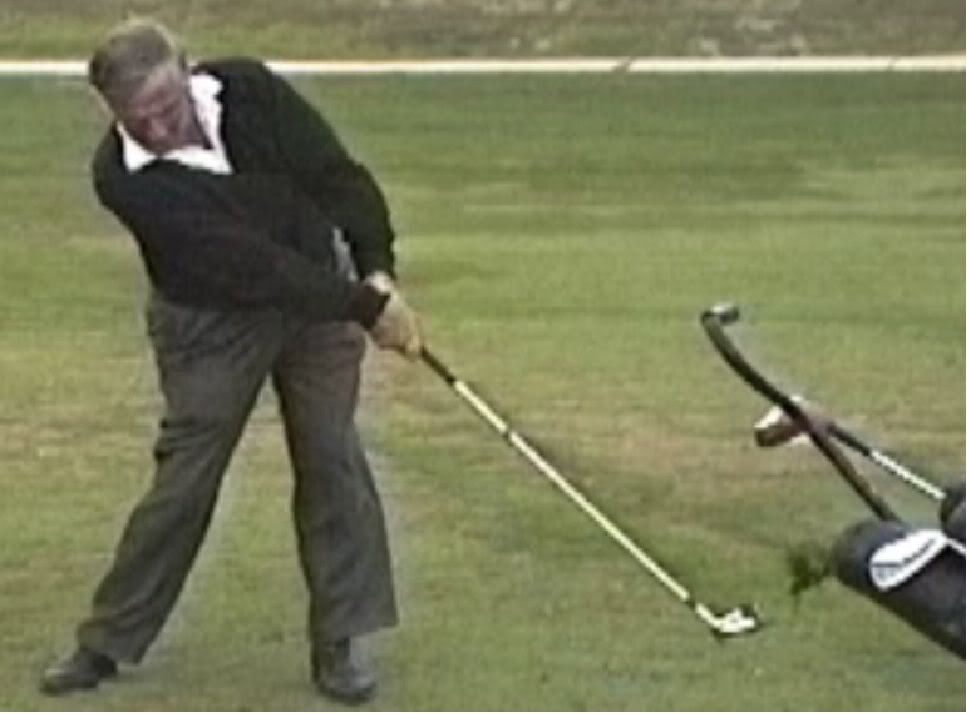 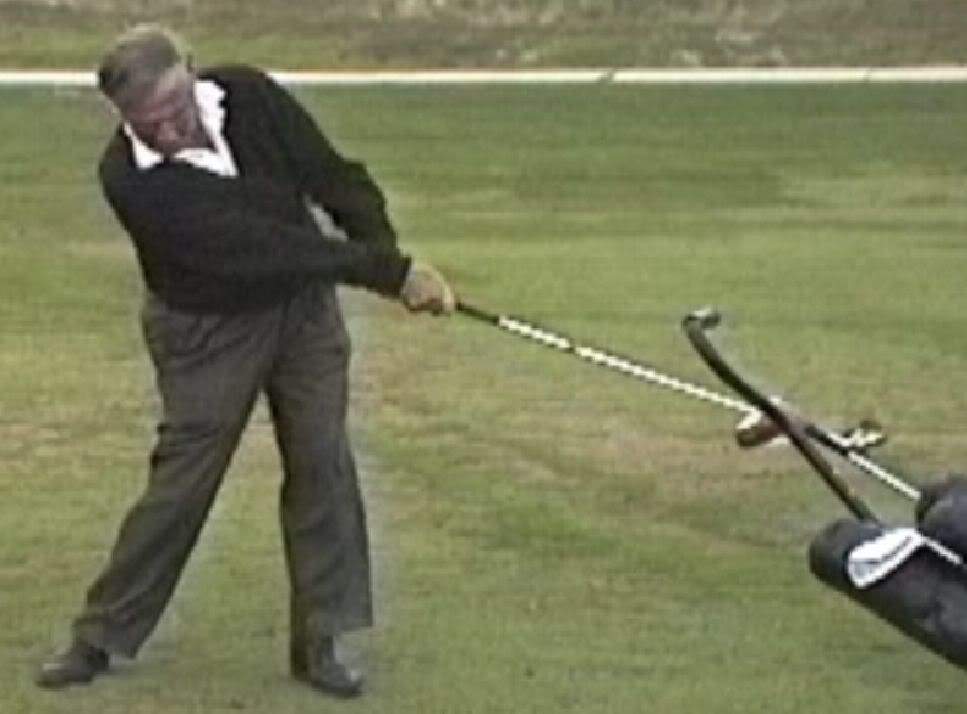 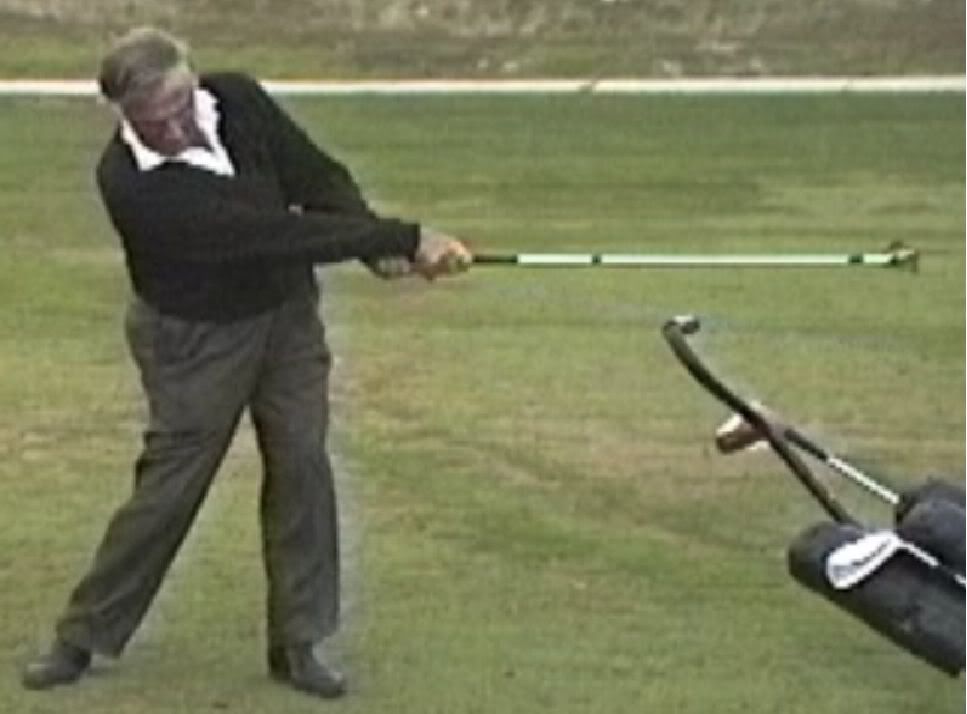 Contrast these photos with those below extracted from my Finish Swivel video. At waist high (Photo 1) -- with Shaft On Plane parallel to the ground and Line -- the back of my Flat Left Wrist is parallel to the Plane, as is the Clubface. This is the correct On Plane Swivel Action. In Photos 2 and 3, I deliberately chose a stop-action showing the back of my Flat Left Wrist similarly approaching -- but not reaching -- the Horizontal. The difference from the first sequence above is that this Action did not occur until much later in the Stroke (with the Hands chest-high and the Clubshaft Position well above the Hands). Even then, much (if not all) of this 'beyond the Plane' action occurred because my Right Shoulder comes Off Plane into the Finish. This 'high' Right Shoulder causes the On Plane Swivel to appear more exaggerated than it really is.    The Golfing Machine is all about Alignment Golf. This term appears twice in the first paragraph of the Preface and is virtually interchangeable with the term Geometric Golf that appears on the front cover. Likewise, LynnBlakeGolf.com is all about Alignment Golf. Know that this post is not about differentiating Instructors. Instead, it is about differentiating alignments. Make sure you know exactly the required alignments. Then, do your best to execute them correctly. That is all you can do. And that is what you must do if you are to play your best Golf. |
When Ben hit that shot, where did the ball go?
|
Alignment Golf...Pure And Simple
Quote:
In introducing my post, I stated that the Alignments evident in this particular Stroke may have been intended and for a purpose. If that purpose was to hit a Straight Shot and the Ball went Straight, then that purpose was served. If the purpose was to hit a Hooked Shot and the Ball Hooked...or a Fade Shot and the Ball Faded...then that purpose was served. But... These are not the Clubface alignments of The Golfing Machine. Respectful of the sensibilities involved, I closed my post stating its purpose as an Alignment issue, not as an Instructor (or personality) issue. I understand your loyalty to your Teacher and appreciate it. In fact, in many ways, I share it. But, I also ask that you honor the spirit of the piece and not mount a defense where there was no attack. Defend the alignments, and I will counter. Defend the man... And there will be no argument. |
Like i said, one is on plane technically (yoda and/or homer) and one is off plane technically (ben).
However, to prove one is more accurate than the other is a debate that no one will ever win. |
O.K. I thought hinge action only occurred from impact to follow through?
In the first photo Ben is past follow through. His left arm is bent and he is swiveling. You stated that follow through is both arms straight and club about 45 degrees to the ground (I couldn't find that in the book). But, HK says both arms straight position as determined by the shoulder position at impact. In fact there are several pics in the book where they show follow through to be well before club about 45 degrees to the ground. 6-B-4-0 #2, 6-B-1-0 #3, 6-A-1 #3, 10-12-B #2 What I am saying is, Ben is past follow through at the point you say he is at follow through. |
Quote:
|
Impact As A Hinge Action, Not As A Swivel Action
Quote:
Regarding whether or not Ben was at the end of the Follow-Through in the first frame, Mathew's analysis above is correct. There was no 'Both Arms Straight' in this Stroke, so we are left with the first frame where the Right Arm has become Straight. And my reference to '45 degrees to the ground, Clubface toe along the line' can be found in 2-G: "Stop at the end of a short Chip Shot--the Club at about 45 degrees. With Horizontal Hinging, the toe of the Club will point along the Plane Line." This is the 'swinging door' of the Horizontal Hinge Action -- the Clubface remaining Vertical to the Horizontal Plane through the Impact Interval. Ben's Clubface is Closing far more rapidly, indicative of Impact executed as a Swivel. You are arguing positions. I am arguing alignments. We all need positions, but to be efficient, those positions must be geometrically-aligned. That is the whole premise behind G.O.L.F. -- Geometrically-Oriented Linear Force. |
Yoda,
As I shared with you before, I absolutely love the finish swivel, and I personally have had great success with students after using a dowel to teach them the finish swivel. What is interesting is that everyone is so infatuated with impact that they try to create it instead of smoothly moving through it to finish. I have really enjoyed this topic and reminds me to ask if you would share your experience last week at Marietta Golf Center when you and Ian watched as I introduced driver loft to a couple of students and how dramatically it affected their ability to not only hit the ball farther and straighter, but also achieve the elusive finish swivel. My contention is that players with insufficient driver loft try to lift, steer, flip, or whatever they can to achieve the proper flight. As we saw last week a "weaker" club may assist the student in achieving a "stronger" swing and shot. I had a great time and enjoyed meeting Ian, look forward to your response. |
"Regarding whether or not Ben was at the end of the Follow-Through in the first frame, Mathew's analysis above is correct. There was no 'Both Arms Straight' in this Stroke, so we are left with the first frame where the Right Arm has become Straight. And my reference to '45 degrees to the ground, Clubface toe along the line' can be found in 2-G:"--Lynn
I disagree...Watch the video. If you are going to classify follow through as right arm straight, it is straight the frame before and the toe is "along the line" and the shaft is "up the left arm" seems like a better spot to call follow through than having the first pic you have posted with the shaft pointed back at his sternum. As far as 2-G, the way I read that sentence it is more of a suggestion to the student to visually see hinge action. Homer defines Follow Through as I stated before 8-11 This section covers the interval between Separation (of Ball and Clubface) and the Both Arms Straight Position as determined by the Shoulder Position at Impact. Ben's "equivalent" of a straight left arm is bent (as I have noticed yours is in some videos I have of your swing)- I AM NOT KNOCKING THAT. Retief Goosen does it as did Lanny Wadkins and others. The pics in the book of follow through have the club up the left arm, not middle of the arms. |
| All times are GMT -4. The time now is 08:08 PM. |