
|
Quote:
Hey Jeff So given your statement in your last post that you now do "imagine that the axis of rotation is a diagonal line drawn between the left foot and the swing center" can we take from that you now acknowledge the existence of the axis of rotation and the pivot center (or swing center)? Have you found two new concepts to adopt? Can we go to the "tote board". One TGM one VJT (or is axis of rotation somewhere in the yellow booK? I dunno) In regard to whether the pivot center is directly between the feet. I like Henny's note that if it isnt it requires compensations and Bucket's that if it is back of center it is draw or pull biased. Good observations there. The "uncompensated" swing will have the pivot center in the middle of the feet. As for your note about the diagram on page 37 of Vj's book, illustration 11, I understand your confusion. I wonder if anyone has noted this before. Interesting. I think it is a typo. That the line drawn from Hogan's left shoulder to low point should be labeled as the Impact Circle Radius. Page 49 ; "The true radius of Hogan's impact circle is a line from his left shoulder (at impact) to a point in front of the his ball (the low point of his swing)". Brackets by the author. Regards OB |
OB
No. I do not believe that there is an axis of rotation between the left foot and the upper swing center. I think that the idea of a pivot axis is merely a mental construct imposed on a human being's 3-D torso movement in space during the downswing. In that sense - in the sense of a mental construct - it makes more sense to me to imagine why a person would imagine a "hypothetical" pivot axis between the upper swing center and the left foot rather than between the upper swing center and a point on the ground midway between the feet. Either way, I don't personally find the mental construct of a pivot axis helpful. I simply cannot understand how this "mental construct" could help a golfer move his torso better in space. I think that one merely needs to position one's head in a "desired' position at address, and then start the downswing with a hip shift-rotation movement that produces secondary axis tilt, that allows the right shoulder to move downplane. Then, by keeping the head stationary, the torso will spiral in a rotary manner towards impact, and beyond impact. I don't understand why an upper swing center that is slightly right-of-center should predispose to a draw, or why it should be described as a compensated swing rather than an uncompensated swing. I have recently posted two driver swing sequences - Tiger Woods and Stuart Appleby - where the head/upper swing center is marginally behind the center of the stance. I cannot understand why their swings would be labeled "compensated" or "draw biased". I don't believe that a small amount of right-of-center positioning of the pivot stabiliser point should predispose to a draw - if the golfer can easily shift his lower body forward onto the lead leg during the downswing and avoid a "hanging back" problem. I think that a "hanging back" problem will only occur in a good golfer if the head is positioned very far right-of-center (where the golfer is overtly leaning to the right). Jeff. |
Quote:
My comments above in caps. We're going in circles. Lets hurry up and get to the debate about the flat left wrist. OB |
OB Left
All your comments about low point relative to ball position have no necessary causal connection with the "mental construct" of a pivot axis. Each individual golfer can simply choose the biomechanical parameters that allow him to hit the ball with the clubhead still moving on a descending path at impact (ball positioned behind the low point) while remaining in good balance during the downswing. Some golfers, like Tiger Woods, swing their arms very fast across the front of their rotating torso in the downswing, and they may prefer to have a greater amount of secondary axis tilt at impact so that they feel that they are in better balance. Therefore, they will have to position their stationary head right-of-center at address when using a driver. Also, some professional golfers prefer to have a rightwards-centered backswing where their weight distribution at the end of the backswing is right-of-center when they use a driver - because they prefer to have the ability to shift their pelvis left-laterally at the start of the downswing so that they can acquire their desired degree of secondary axis tilt by impact. All these biomechanical choices are individual choices that do not require the golfer to think in terms of a centralised pivot axis, and I do not think that I have learnt anything useful if somebody chooses to define their swing as being "compensated" rather than "uncompensated" simply because that person harbors a hypothetical "mental construct" of a pivot center and a centralised pivot axis. The only point regarding the pivot action that I believe is an essential requirement is the idea of a pivot stabilising point (eg. head or upper swing center), but there is no mandatory requirement that the pivot stabilising point has to be perfectly centralised between the feet. The desired position of the pivot stabilising point depends on the desired degree of secondary axis tilt at impact - that will allow the individual golfer to swing his arms very fast while remaining in good balance. Jeff. |
Quote:
I'm not going to argue centered head. I like it. My point is the point between the shoulders bobbing or swaying requires a compensation. Lots of guys do it. Does not make it right. Left, center, or right centalized all work. Some better than others. |
HB
I agree with you. If we agree that the upper swing center is the pivot stabilising point, then the pivot stabilising point must not bob or sway. The idea of a pivot stabilising point (whether it is the head or upper swing center) remaining stationary is a very sound concept. I have only questioned the belief that the pivot stabilising point has to be perfectly centralised between the feet and the idea that a golfer pivots around a vertical pivot axis that is centralised between the feet. I think that if the pivot stabilising point is slightly left-of-center, or slightly right-of-center, that it can still perform its stabilising role efficiently - as long as it does not bob or sway. There is no bobbing-or-swaying of Tiger Woods' and Stuart Appleby's upper swing center (pivot stabilising point) even though it is not centralised between their feet. Although I personally prefer to keep my pivot stabilising point more centralised - like Aaron Baddeley - I think that it is a personal swing preference, and not a mechanical/geometrical imperative. Jeff. |
Quote:
There are ball flight implications . . . . based on the clubhead path's that can result all things being equal. |
Elephants Graveyard
Quote:
You write as if you have discovered some new 'wahoo' information. The FACT is that I have written on this subject many times, including in at least one thread where you were active. Check my archives: Homer Kelley recommended 'central' axis but said that the important thing was that the golfer set his Head at Fix -- central, left or whatever -- and then leave it there. How many times to I have to reiterate this truth? Please, tell me: How many times? Stop revisiting this burial ground of old news. Especially since you apparently delight in using it as a gambit to 'disprove' the work of THE "authority figure" -- using your words -- on this site. Find something new to "question" -- I'm sure you will -- but get off this bus. |
12PB
I think that there can be ball flight implications as you claim - if a golfer doesn't know where to position his ball (for a given position of the pivot stabilising point). That's why each individual golfer needs to know where his low point is going to be on the ground - based on the position of his pivot stabilising point in space - and he should then position the ball accordingly. Here is Aaron Baddeley's clubhead swingarc and point "X" shows where the low point of his clubhead swingarc is located. Knowing that fact, he can simply position his ball behind the low point to ensure a descending clubhead path at impact. 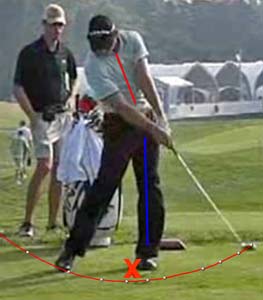 The blue line represents the braced/straightened left leg. The red line represents the braced spine (and the degree of secondary axis tilt) at impact. By keeping the pivot stabilising point stationary, and having a braced skeletal structure (spine and left leg), the low point of the clubhead swingarc should always be at the same point - point "x". That allows him to place his ball just behind the low point to consistently ensure optimum impact alignments. Jeff. |
Yoda - I take delight in acquiring greater insights regarding the golf swing.
Since this thread started, I have gained greater insights regarding this issue of the "pivot axis and pivot center". In particular, I have gained two new insights. The first new insight was gained from your post which stated that HK asserted that one should position the head at its impact fix location and then keep it there - without automatically implying that the head had to be centralised at address. At the start of this thread I was under the distinct impression that the head had to be centralised between the feet. The second new insight that I gained came from OB Left when he stated with respect to HK's definition of a pivot center -: "SOME POINT on the body kept stationary throughout the Stroke, to stabilize the motion". I didn't initially realize that the definition of a pivot center didn't automatically imply that the pivot stabilising point has to be centralised to efficiently perform its function - stablise the motion. In other words, I think that the phrase "pivot stabilising point" may therefore be a more exactingly correct definition of that "SOME POINT". Then, in conclusion, I have learnt that HK primarily implied that a golfer needs a pivot stabilising point that does not necessarily have to be centralised between the feet. That's a different perspective than the perspective expressed by many TGMers at the start of this thread. So, hopefully, I am not the only LBG forum member who has gained new insights as a result of this prolonged, but fruitful, discussion. Jeff. |
Much Ado About Nothing
Quote:
You really are trying my patience here, and trust me, I have better things to do with my time. Thirty years ago, the 5th edition of The Golfing Machine defined 'Pivot Center' as follows: "PIVOT CENTER -- Some point on the body kept stationary throughout the Stroke to stabilize the motion."Homer presumed a certain intelligence in his readers, an intelligence that would instantly understand that the term "some point" meant any point -- central or otherwise -- chosen by the golfer to stabilize the motion. What could be more clear? Now, you come along with this 'clarification': ". . . I think that the phrase "pivot stabilising point" may therefore be a more exactingly correct definition of that "SOME POINT".Can you not see that your phrase is nothing more than an incomplete definition of the term under discussion (Pivot Center)? A term Homer adequately defined for any reasonable person three decades ago? And while I'm here . . . Until you start signing your posts "J" (whereupon I will immediately rename this forum Golf by J), you are specifically prohibited from using the initials "HK" when referring to Mr. Kelley (alternatively, Homer Kelley or simply Homer). You may not respect his "Authority", but at least on this site, you will respect his name. |
Mr Kelley
Lynn makes a good point about "Mr. Kelley". In my time with Alex Sloan he always refered to "Mr Kelley". It really stuck out. The tone of voice he used when he said it spoke volumes. To me it means that that appellation was always used by Mr Sloan and Mr Blake because it was earned and signified their great respect for him. Who is this man that Lynn Blake and Alex Sloan revere so much? The more I learn about the yellow book and hear Lynn talk the better I understand it. That is why I read this forum
|
I apologize for using the abbreviation "HK" in one of my posts. I would never disrespect Homer Kelley and I never thought that it would be disrespectful to abbreviate his name to his initials.
I have often used abbreviated initials when replying to posts, and I never intended my use of abbreviated initials to be disrespectful. I therefore apologize to Hennybogan (for using the abbreviation HB) and to all other forum members whose online names I have abbreviated. Regarding the issue of respecting his "authority", I wonder if Homer Kelley would have wanted people to respect his "authority" or whether he would have simply wanted people to treat his amazingly insightful ideas/insights with a great deal of thoughtful consideration. I would imagine that he would have felt that the clarity and logic of his ideas could stand up to intense intellectual scrutiny, and I cannot easily imagine that he would expect people to unthinkingly accept his ideas simply because he is deemed by some people to be an "authority". Jeff. |
Quote:
I have noticed that if you stick to Mr Kelley's definitions and concepts as written, without redefining, re naming or mincing in new concepts that werent there in the first place............. TGM has withstood the scrutiny every time. OB |
Jeff,
It sounds like you best be careful here.... Lest you be "put to the question". NMG |
Quote:
HB is good enough for me. I did not write the definitive work on GOLF. |
Homer Kelley: LBG Authority Figure
Quote:
He did, however, insist that those who questioned his ideas bring the same support to their argument that he already had brought to his own. Namely, scientific proof. Also, he did not suffer fools gladly, and he would have considered it a total waste of his time to debate "what the definition of 'is' is". The root word of the term 'authority' is author, and Mr. Kelley authored the most original work in the history of golf instruction. Working with tools that today could only be considered primitive, he published the solution to one of the great puzzles of athletic endeavor. He was a humble, but resolute, intellectual giant who earned his right to the title authority through his genius, and in his own words, "the sweat of blood on every page". For five years now, I have done my best to help those genuinely interested in understanding his teachings and personal philosopies. At the same time, those dismissive of that authority or who otherwise cavalierly reject his work can generally expect to see two things from me: My back . . . And the dust from my sandals. |
Yoda
I agree wholeheartedly with your sentiments. I think that all golfers, or golf instructors, who "cavalierly reject his work" should be treated as you suggest. Jeff. |
yes but...
Quote:
The English word authority comes from the Latin word auctoritas which literally meant such things as “a producing”, “production”, “invention”, “cause”. Auctoritas in its turn came from auctor which meant “producer”, “father”, “progenitor”, “creator”, “maker”, “inventor”, “founder” and so on. In the English language, the Latin words auctor and auctoritas have become corrupted to “author” and “authority”. In short: The auctor of a matter or thing is the one who made or established it, and also, the one who originally taught something. ________________________ On Science.... (a word that is as misused as 'centrifugal force') There are three "ordinary" ways of gaining knowledge: chance, trial and error and generalization from experience. They are used by nearly everyone but none of them are "scientific". Some people are equiped with another method of gaining knowledge: logic... ability to reason things out. That is not scientific either. Going far beyond these elementary methods of gaining knowledge, even far beyond the method of logic (which Mr. Homer Kelly used) is a method of seeking truth we call research or scientific inquiry. Science is a method of study by which, through careful and exhaustive investigation of all the ascertainable evidence bearing upon a definable problem, we reach a solution to that problem. Research.... SCIENCE is a instrument... a method that is only a few centruries old and seems today to be mankind's most reliable means of advancing knowledge. On Appeal to 'Authority'... Its human nature to rely upon authority. When tribes were attacked or experience flooding or plagues, people naturally wanted to know why... they went to the priests. The reliance on authority grew from the idea that great thinkers of the past were able to discover the truth. But history has shown great thinkers are almost alway proven wrong... eventually. A book is a snapshot of the generally accepted state of a body of knowledge at that time. The danger of reliance on "authority" as a basis for argument should be obvious. Its also one of the logical fallacies. So then... Are we endeavoring on a truth seeking venture of the scientific variety whereby all commonly accepted premises are subject to questioning... to scrutiny and yes possibly even rejection? Or are we involved in a modern-day sports oriented "priest-craft" where by any dissension... any evidence to the contrary... any questioning of the authority or the priests interpretation there-of leads one to be "put to the question"? So then... what exactly is the purpose of LBG... to advance knowledge or is it a mere personality cult. |
R-e-s-p-e-c-t
Quote:
However, with that privilege comes responsibility. And the cornerstone of that responsibility is respect for Homer Kelley's work and the mission of this site. Adhere to this standard, and you will receive little censure from me. :salut: |
Quote:
Until we understand Homer Kelley's work 100%, nothing else matters much... Just my opinion. :golf: Kevin |
Wagons Ho!
Quote:
Homer Kelley understood that much amplification of his work was both necessary and inevitable (1-H). He knew that his seminal approach (Scientific Golf / 1-G) had opened a whole new territory for those interested in "such things". For that reason, he referred to his students as "pioneers". Indeed. :salut: |
nm golfer
I think that "science" as it applies to the golf swing is the idea of seeking to produce testable theories regarding the mechanics/biomechanics/geometry of the golf swing, and if those testable theories have a high verifiability factor and a low falsifiability factor when experimentally tested (using "objective reality" as the gold standard), then those testable theories could represent the "best" theories. The theory, among all existing theories, that has the highest verifiability factor and the lowest falsifiability factor is the "best" theory - from my perspective. That's why I hold Homer Kelley's golf swing theories in such high regard - his theories regarding the golf swing could be accurately regarded as being the "best" (in the present-day world of existent golf swing theories) - in the sense that they have the highest verifiability factor and the lowest fasifiability factor. It doesn't mean that one cannot theoretically develop another swing theory that will be better - by having a higher verifiability factor and lower falsifiability factor - it simply means that if Homer Kelley's theories are presently regarded as representing the "best" theories then it sets the bar very high - and for that accomplishment he deserves an enormous amount of respect. Yoda also deserves an enormous amount of respect as an "authority" - as a person who most clearly understands Homer Kelley's theories and can defend them from being misunderstood and misrepresented. I am an example of a person who has unintentionally misunderstood and/or misrepresented Homer Kelley's theories, and I am always appreciative when Yoda "corrects" me regarding the "correct" understanding of Homer Kelley's golf swing theories. I may disagree with Yoda regarding certain golf swing issues, but I am very willing to regard him as being an "authority" regarding Homer Kelley's body of work. I do not believe that Yoda equates being an "authority" on Homer Kelley's body of work as being equivalent to being the "ultimate authority" that determines the level of verifiability/falsifiability of any proposed golf swing theory. Jeff. |
Strike Two . . .
Quote:
I have known people like you all my life. You take much, produce little, and in general, delight in stirring controversy and dissent. You are, for the most part, mere 'friction' in the system of life. My site, its many Forums and diverse contributors speak for themselves. One more crack like this, and you're history. |
Was Mr. Homer Kelley a human or an errorless cyborg ? Errare humanum est..., isn't it ?
I am sorry to sound bitter, but such remarks that someone is the only one "authority" worth listening to usually makes me be more sceptical when approaching to listen to such "authority"...just as inquisition caused people stay away from religion. Cheers |
Quote:
Science can be a religion too. Modern science would not have been possible without the world view of "priests". I don't think it really is human nature in this world anyway -to rely upon "authority". Modern science sees man and reason as "autonomous". Many have a science god and have sacrificed unto him the very reason they seek to promote. So let's not be to quick to trot out the old cult deal. Hope you had a nice Christmas Mandrin :happy3: |
Quote:
How many people go to McDonald's and get pissed because they don't serve up chicken chow mein. Lynn has been more than generous by giving others voice here . . . Jeff has his own deal . . . even a doofus like me has a forum. But Lynn pays the bills and Homer Kelley is honored here. Most people wouldn't show up at somebody's house and talk about how their dead granny's award winning chicken pie tasted like dawg food. They may just get kilt or worse where I'm from. There's dissent . . . then there's disrespect. |
Truth Serum
Quote:
Check it out. To the contrary, LynnBlakeGolf.com offers a flexible framework that accomodates and encourages a wide spectrum of opinion, dissent and debate. A glance at a few of our more than 6,000 threads and almost 60,000 posts will attest to that fact. We even have a dedicated forum, The Lab, whereby members can put forth new material, largely theoretical, without fear of retribution or ridicule. Finally, there's Jeff's stuff, most of which I perceive as Memorandums For Understanding written for his own edification, but which he offers to us for assessment and critique. That said, I make no apology for the work we do in helping people understand The Golfing Machine and apply its concepts to their games. It's a large part of 'what we do'. Not the only part, to be sure, but a large part. :salut: |
Not questioning Respect....
Quote:
I don't intend to take you any further off topic so this is the last I will say on this matter. I'm not questioning R-E-S-P-E-C-T or anybody's self-proclaimed (or earned) 'authority' . Everyone deserves it (at least at the outset) and some undoubtedly are (authorities). I'm questioning the science (rather lack there-of) in the book. I'm questioning what are acceptable subjects for discourse in the pursuit of knowledge if that is indeed the mission of Golf by Jeff. Research.... Science... has arguably five steps or identifiable traits. 1) Identification of the problem (statement) 2) Collection of all of the essential facts (indisputable basic assumptions...i.e. the premises) 3) Selection of one or more tentative solutions (thesis) 4) Evaluate choosen solutions to determine if they are in accord with the facts (data collection/analysis... perhaps some theoretical modeling too) 5) Select the final solution (theory) Science is a processes whereby thesis gets elevated to theory, but even theories aren't "cast in stone". The scientist is epitomized by: accurate observation, objectivity, willingness to consider all evidence, recognition of causal relationships and demonstration of originality and independence of thought. Anything conclusions arrived at by any means other than the above given framework are not 'scientific'. TGM is not scientific (there's no data... many of the premises have been debunked). TGM is not a scholarly report; TGM is an essay that is full of the author's conjecture. Syllogism is not science either... here's a common examples of a syllogisms: -Some Good golfer's hands are seen to slow down -Joe is a good golfer therefore Joe's hand's slow down..... NO or -Some Good golfers maximize the angle between hips and shoulders (X factor) -Joe turns his hips almost as much as his shoulders therefore Joe is not a good golfer... NO or -Some Good Golfers hips face the target at impact. -Joes hips are parallel to the target line at impact therefore joe can't be a good golfer.... NO Syllogisms do not lead to scientific conclusions... Infact they are probably not even accurate conclusions (particularly if Joe can play). So its all about asking the right question.. (Problem statement... is it testable?) Defining the research study (possibly experimentation or perhaps mathematical soln.?).... all the while remaining objective towards the pursuit of knowledge. Predjudice and premature conclusions or discounting a possibility simply because an authority has rejected it has no place in scholarship. The Scientific method.... a scientific attitude implies basing generalizations not upon the authority of others or upon abstract logic or one's personal opinions but on carefully observed facts. (Emphasis should be on CAREFULLY OBSERVED) Merely hitting the range with a trackman in hand does not constitute science or scientific method. Conclusions drawn from such haphazard research are likely as fallacious as those drawn from the "lessor" truth-seeking methods. Ultimately the value of any theory is its efficacy.. at explaining possible outcomes or in the case of golf instruction producing winners. On that account, at least in my mind, the jury is still out on TGM. How many winners has it produced? Yes I know... Bobby Clampett had a run of luck but given the time its been around and the number of adherents, one would think, simply by the law of large numbers, more winners would have been produced... that is if it is as good as "they" say. P.S. I hope I don't get banned like Mandrin says I will for simply stating my opinions. I respect Homer... really I do. |
(Almost) Zero Tolerance
Quote:
I can handle dissenting opinion, but my tolerance for insult has grown quite small. See my Post #23 here: http://lynnblakegolf.com/forum/showt...?t=5758&page=3. :salut: |
Quote:
Today many of us think we need another "enlightment". Today we have the Priests (man made global warming adherents for example) destroying real scientist's careers and even wanting to pass hate speach laws against the "deniers" because they dare question their politically expedient conclusion (which is that we must tax carbon). Bucket... Never mistake pseudo-scientists and their ilk (the Al Gores of the world) with real honest hard working "yeoman" scientists. And never mistake Me for Mandrin. I don't agree with much of what he says and consider him one of the former (i.e. pseudo). Also, I don't write anything like his mostly childish mal-formed drivel.... Please. I AM NM not mandrin of la mancha (slayer of windmills) |
Quote:
Opinion is one thing but then to roll up to somebody's house and take a piss on the rug is another thing. The "cult" thing? Come on dude . . . . Some of these flaws y'all come up with and say Homer was a doofus about are putting words in his mouth anyway. Who would pay your own cash to take a lesson from? |
Quote:
Cheers Quote:
OK, perfectly clear, Yoda. Thanks for your response. My intentions were not evil-hearted - vide my words to Bucket above. Cheers |
Quote:
As for your question... I would have to think about that. Dead or alive? One thing is for certain though... arrogance is one trait that eliminates them from my consideration. Teachers might help (might hurt too) but ultimately I believe what Gurdjeiff said: A man can only learn by his own efforts. |
Quote:
I knew Mandrin was Al Gore. |
Quote:
let's say dead and alive . . . . you figure out where to put Mclean in that scheme? |
the chilling effect...
Bucket...
Much as I'd like to carry on this off topic discussion with you, I have been put on notice by our host who I learned also takes issue with the term "personality cult"... Since I wish to continue reading this forum, and I cannot risk the umpire declaring a third strike against me, I must now go to lurk mode which I do regret because in so doing I become what he says I am (yet God knows I'm not): a taker not a giver. Best to you bucket. |
nm golfer
You wrote-: Research.... Science... has arguably five steps or identifiable traits. 1) Identification of the problem (statement) 2) Collection of all of the essential facts (indisputable basic assumptions...i.e. the premises) 3) Selection of one or more tentative solutions (thesis) 4) Evaluate choosen solutions to determine if they are in accord with the facts (data collection/analysis... perhaps some theoretical modeling too) 5) Select the final solution (theory) Science is a processes whereby thesis gets elevated to theory." I disagree - especially with your last statement which is a tautology. I have a different approach to the idea of a scientific endeavor. I think that science starts with a theory that has informative content/predictive content. Then, the second step, is experimental testing to see if the theory can be verified and also not falsified. A theory only acquires scientific validity not only in proportion to its ability to be verified, but also according to its ability to withstand attempts at falsification. Most scientists realize that a low falsifiability factor is an essential element of the term "scientific conclusiveness", and that's why I mainly concentrate my efforts on falsification rather than verification. Most reasonable scientific theories have a high verifiability factor, but not necessarily a low falsifiability quotient. That's why many wise scientists set up their scientific experiment to rigorously test their theory for its falsifiability quotient. In other words, they deliberately try to falsify their own theory - knowing that a failure to falsify their theory may make it the "best" present-day theory. A wise scientist knows that he has not conclusively proven his theory that "all swans are white" by observing more-and-more white swans because he knows that his theory is not necessarily more true after having observed 1,000 white swans than it was after having observed 100 white swans. It is easier, and more fruitful, to "test" his own theory by looking for one black swan (non-white swan) because it only takes one black swan to disprove his theory. That's how I approach golf swing theories. I look for a golf swing theory that is likely to have a low falsifiability factor, and I then try to disprove the theory via a rigorous attack. If I cannot falsify the theory, then my respect for the theory increases - because, in my mind, it obviously has a low falsifiability factor. I think that any golf swing theory, which is not only verifiable, but that can also best withstand rigorous falsification challenges represents the "best" present-day theory. There are no "true" golf swing theories in terms of absolute truth. There are only "degrees of truth" in terms of the theory having a high verifiability factor and a low falsifiability factor. Using that intellectual approach as to what represents a "scientific endeavour", I think that TGM theory regarding the golf swing is a "scientific endeavour" in the sense that TGM theory can be tested for its verifiability and falsifiability quotients. Jeff. |
Quote:
You're a smart dude. But to drop the cult bomb wasn't real smart if your intent is to stick around. Best to you as well . . . . our off topic discussion would be interesting. |
Therein lies the rub...
Quote:
I stand by my assertion its starts with problem statement or at-least conjecture. Then assemblage of all known facts... then development of the thesis' Anyway... I'm going under for fear of being purged... PM if you wish to discuss work (as in the physics sense) or anything else for that matter. best wishes |
| All times are GMT -4. The time now is 11:17 PM. |