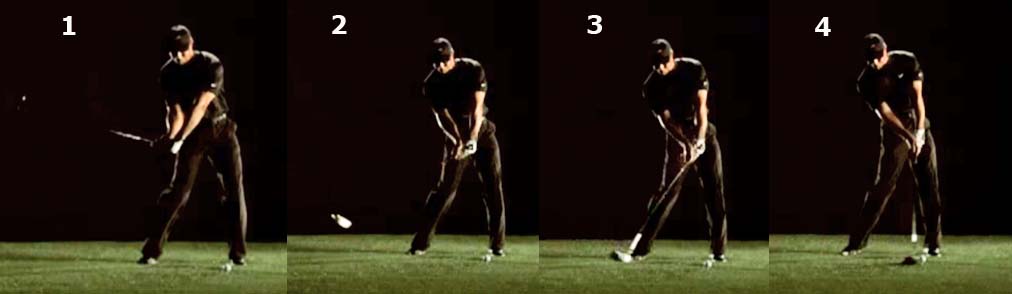
Here is a series of images showing the release of PA#3 in Tiger Woods swing.
One cans see that both PAs 2 and 3 are releasing.
Although PA#2 must sequentially release before PA#3 in a swinger, HK states that they can overlap. What determines the degree of overlap of the release of PA#2 and PA#3? Does the position of the right elbow and the position of the right forearm (degree of passive release of PA#1 at every particular time point in the pre-impact phase of the swing) determine the degree of overlap? Should a golfer consciously control the rate of counterclockwise rotation of the left forearm during the release swivel phase of the swing - so as to affect the rate of release of PA#3?
Why did HK refer to PA#3 as the transfer PA? The word transfer implies the transfer of power without any independent production of power. Do you think that in Tiger Woods full driver swing, PA#3 is independently responsible for the production of significant swing power (relative to PA #4 and PA#2)?
Here is a series of images showing the release of PA#3 in Tiger Woods swing.
One cans see that both PAs 2 and 3 are releasing.
Although PA#2 must sequentially release before PA#3 in a swinger, HK states that they can overlap. What determines the degree of overlap of the release of PA#2 and PA#3? Does the position of the right elbow and the position of the right forearm (degree of passive release of PA#1 at every particular time point in the pre-impact phase of the swing) determine the degree of overlap? Should a golfer consciously control the rate of counterclockwise rotation of the left forearm during the release swivel phase of the swing - so as to affect the rate of release of PA#3?
Why did HK refer to PA#3 as the transfer PA? The word transfer implies the transfer of power without any independent production of power. Do you think that in Tiger Woods full driver swing, PA#3 is independently responsible for the production of significant swing power (relative to PA #4 and PA#2)?
Jeff.
well interesting topic heading down the morad road?
I have another question (which is really a rephrasing of my original question).
I presume that in a swinger's action, that the release swivel action represents the release of PA#3 and that the left hand roll over is due to left forearm rotation. Should a swinger simply allow the left forearm to rotate passively in response to the clubhead's momentum (due to the active release of PA#4 and the passive release of PA#2) or should a swinger actively rotate the left forearm in a counterclockwise manner as the club approaches impact?
In a sequenced release, you state that PA#3 releases when the left wrist is level (which means that the left wrist is already uncocked - PA#2 fully released). Do you perceive that statement as an imperative or an option? What would prevent a golfer from releasing PA#3 while PA#2 is still being released?
In a sequenced release, you state that PA#3 releases when the left wrist is level (which means that the left wrist is already uncocked - PA#2 fully released). Do you perceive that statement as an imperative or an option? What would prevent a golfer from releasing PA#3 while PA#2 is still being released?
In a sequenced release, you state that PA#3 releases when the left wrist is level (which means that the left wrist is already uncocked - PA#2 fully released). Do you perceive that statement as an imperative or an option? What would prevent a golfer from releasing PA#3 while PA#2 is still being released?
Jeff.
Jeff,
The left wrist is fully released when its uncocked wich is not the same thing as level. HK made this statement on one of his tapes. In a sequenced release
2 and 3 still overlap so 3 starts before 2 is fully uncocked/released - when its level. If 3 starts to early the club and left arm would lose its in-lined condition and you would get an off plane downstroke.
Jeff,
The left wrist is fully released when its uncocked wich is not the same thing as level. HK made this statement on one of his tapes. In a sequenced release
2 and 3 still overlap so 3 starts before 2 is fully uncocked/released - when its level. If 3 starts to early the club and left arm would lose its in-lined condition and you would get an off plane downstroke.
I think that it has something to do with the right wrist being level throughout the stroke - Daryl mentioned something like this along time ago. It had always struck me as odd that if the swinger truly sequences the release oc acc2 then acc3 ...how does the left forearm "know" when to roll...ie...how does it know when the left wrist is level....why doesn't the left wrist go to uncocked and then start to roll. I think that the level right wrist, impact fix alignments etc make this happen in some way....
So pre-release - left wrist cocked / right wrist level /right elbow bent
during acc#2 release - left wrist uncocks/ right stays bent / therefore right elbow must straighten.
IN THEORY - (maybe in reality - I am not sure whether this is real world or just a wonderful "seems as if" - either way it works) the left wrist uncocks to level and then acc#3 releases which requires some straightening of the right elbow - I guess that in swinger it is due to CF force rather than muscle power.
I am not sure that anyone has really got this release thing sorted out in reality but Homer did seem to have wonderful idea of uncocking on plane and rolling on plane in CAPS and italics in mechanical checklist. That is the way to achieve the right kind of release IMO. What actually happens in the real world is a matter for 3 D analysis machines etc... but the way to achieve an on plane release is through the uncock and roll on plane concept. That requires pp sensation driven swing - hands' sensations controlling the pivot.




 Linear Mode


