
|
Active pivot versus reactive pivot
I have decided to start this thread because I thought that it may interest forum members to understand why some golfers may choose to use a reactive pivot rather than an active pivot in their golf swing. I will present my opinions on this issue, and you are free to agree, or disagree with my opinions.
I will start off by discussing the active pivot swing. The active pivot swing is best exemplified by Ben Hogan in this swing video. http://www.youtube.com/watch?v=QL_6M_xZvq0 The pivot starts from the bottom-up - with a shift-rotation movement of the pelvis. Presume that a golfer rotates his pelvis 45 degrees in the backswing, and ends up with his pelvis facing the target at the finish position - that represents 135 degrees of pelvic rotation during the downswing/followthrough/finish. During the initiating pelvic shift-rotation movement - also called the hip squaring phase of the downswing - the pelvis shifts left-laterally and also rotates 45 degrees so that the pelvis is square to the ball-target line by the end of the early downswing. One can see that hip squaring action in in Ben Hogan's initiating lower body move. During that pelvic shift-rotation movement, the lower lumbar spine moves leftwards, and if the head remains stationary, then the golfer develops a greater degree of secondary axis tilt. Then, when the shoulders start to rotate perpendicularly around the rightwards tilted spine, the right shoulder can move downplane - due to the fact that the initiating pelvic shift-rotation movement first produced secondary axis tilt. If the right shoulder moves downplane, it helps direct the arms to approach the ball from an inside track (getting into the "slot"). The upper torso rotates after the pelvis and the force moving the upper torso comes partly from the lower torso via torsional forces transmitted up the spine and external torso musculature, and partly due to the active muscular contraction of mid-upper torso muscles. In other words, one can conceptually think of a torque generator situated in the pelvis and that torque generator starts the pivot action. That torque generator first rotates the pelvis and then secondarily torques the upper torso via torque forces transmitted up the spine, paraspinal muscles and external torso musculature (the X-factor idea). For the pivot action to work properly (as described) the golfer needs to have a certain level of hula hula flexibility - which I will simply define as the ability to independently rotate the lower torso without necessarily rotating the upper torso. Here is my simple test for estimating a golfer's level of hula hula flexibility. Adopt a golfers posture and then perform a backswing action (without a golf club) and stop at the end-backswing position - ensuring that you have made a 45 degrees pelvic rotation and a 90 degrees shoulder rotation (relative to the ball-target line). Have a friend stand directly behind you and get him to place his right palm on the front of your right shoulder, so that he can prevent your right shoulder from moving forward, and so that he can sense the "pull" on your right shoulder as you perform the next maneuver. Then perform a hip squaring action - an initiating hip shift rotation move. If you can rotate your pelvis 45 degrees to a hip-square position while keeping your right right shoulder back and your friend doesn't feel any pull-pressure against his palm - then you are ultraflexible. If you can rotate your pelvis about 20 degrees before your friend feels a tremendous amount of pull-pressure against his right palm (due to the right shoulder being pulled forward) - then you have moderate hula hula flexibility. If you can only rotate your pelvis about 5-10 degrees before the right shoulder moves forcefully forward in response to torque forces transmitted via the spine, then you only have a small amount of hula hula flexibility. If you cannot rotate your pelvis at all without your right shoulder immediately moving forward - then you have zero hula hula flexibility. I personally have zero hula hula flexibility due to severe spinal inflexibility problems and I cannot generate even one degree of dynamic torso-pelvic separation (one degree of dynamic X-factor) at the start of my downswing if I use the standard pivot action. The significance of this fact is that I cannot get my right shoulder to move downplane - because the right shoulder immediately moves outwards (roundhouses) as soon as the pelvis starts to shift-rotate. By the time my pelvis moves left-laterally enough for me to acquire a certain level of secondary axis tilt, my right shoulder has already roundhoused and I have already come OTT. Consider a secondary problem. The following composite photo shows Tiger Woods and Adam Scott at the end-backswing position when using a driver. 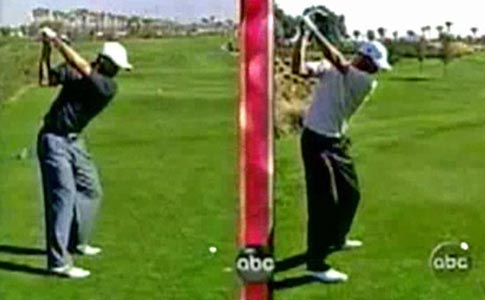 That's my idea of a desirable end-backswing position for a swinger - the hands are well behind the right shoulder, the left arm is across the shoulder turn angle, the clubshaft is parallel to the ball-target line and the right forearm is vertical to the ground. I lack the torso and left scapula flexibility to get to that end-backswing position. Here is a photo of me at the end of my backswing - using a short training club.  Note that I cannot get my hands behind my right shoulder, and that my right elbow has to fly (jut backwards) so that my right hand can move outwards enough (in the direction of the ball-target line) to reach my left hand. That's a disadvantageous hand position - because it is too close to the ball-target line and it is too easy to come OTT from that non-deep hand position. If you combine the fact that I have zero hula hula flexibility and the fact that my hands are too close to my my toe line at the end of my backswing, then you should be able to understand why my hands immediately go OTT when I use a standard active pivot action. That's why I have to use an alternative swing approach to get my hands and therefore clubshaft to come more from the inside along a shallower attack angle (rather than too steeply down from an OTT position). My personal approach is to use a reactive pivot action, and not an active pivot action. I start my downswing by pulling (throwing) my hands straight down-and-out onto the plane in the direction of the ball (aiming point) before my torso moves reactively. That allows me to get the clubshaft coming from the inside (desired approach for an in-to-square clubhead arc). In other words my "educated hands" have learnt how to get my left arm, and therefore clubshaft, into the optimum downswing "slot" by starting the downswing from the top with an active hand movement (rather than starting from the bottom with a pelvis-shift rotation movement). I pull my hands down by pulling with my left arm (ala the Leslie King swing methodology) and I do not use the alternative technique for throwing my hands/clubshaft down-and-out on the plane (TT's "right arm throw" technique). Here is a link to the Leslie King method of starting the downswing. http://www.golftoday.co.uk/proshop/t.../lesson11.html Here is a photo showing which torso muscles I use to pull my left arm downplane. 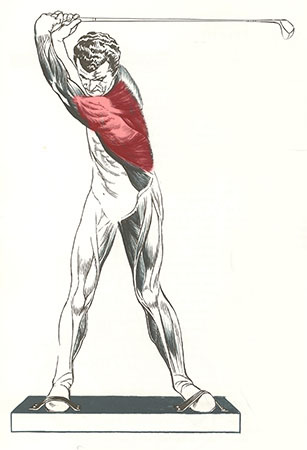 What happens to my torso when I actively pull my left arm downplane at the start of the downswing? The active left arm pull downplane secondarily pulls my right shoulder downplane via forces transmitted through the intact power package assembly. That also causes my upper torso to rotate secondarily as my right shoulder moves downplane, and the upper torso rotation transmits a force down the spine to my pelvis and causes my pelvis to shift left-laterally. In other words, my hip squaring action (pelvis shift-rotation) occurs secondarily (reactively) in reaction to my active left upper limb pull action (which starts the downswing). Also, the torso torque forces are moving down my spine (and not up my spine as occurs in an active pivot action). I personally think that my reactive pivot action is a viable alternative for elderly inflexible golfers who cannot perform an active pivot action due to a lack of hula hula flexibility or other physical incapacities. I also think that flexible golfers can consider using this reactive pivot action if they have an OTT problem due to hip spinning, an excessive pelvic slide action that they cannot control and that causes their head/spine to slide ahead of the ball during the downswing. I think that flexible golfers can also use a reactive pivot action if they want to use TT's "right arm throw" swing action as an alternative swing style. Jeff. |
I kinda like it
I think your primary lever assembly is well supported for a little drive loading! I like "where" your right elbow is at...at least in relation to the left arm flying wedge. I have discovered just how minor-major the axis tilt really is i.e. minor movement...major importance. You cannot manage even a couple of inches? Most people either do not do it...or overdo it. Start down waggle!
|
Okie
I agree - I am well positioned for starting a hitting action. However, I am a swinger and I would love to get an additional 1/4 rotation so that I can get my hands behind my right shoulder like TW and AS. It is very difficult to swing from a shortened backswing position if one doesn't use an active pivot action that increases loading pressure at PP#4. I never "feel" a sense of pressure at PP#4 in the backswing because I cannot get my left arm far enough back against the chest wall. I obviously don't "feel" any sense of pressure at PP#4 in the downswing because I am pulling the left arm down-and-out on the plane - away from the chest wall. Jeff. |
Jeff:
I absolutely love the analytic content of your posts....in the last two weeks, i have adopted some of your comments and they look like they're kicking in....keep 'em coming.... |
Longest driver in the world and pound for pound no one is close.
Looks like active pivot to me? http://www.youtube.com/watch?v=CCpiHzmnBws |
mb6606
I agree with you 100%. Jamie Sadlowsksi has a very active pivot action. He couldn't hit the ball nearly that far using a reactive pivot action, which is a much weaker method of releasing PA#4. Here is another link that demonstrates his amazingly efficient active pivot action. http://www.youtube.com/watch?v=0h-5zCB4Lz I wish I had his degree of body flexibility. My swinging problems would be significantly improved if I had his degree of hula hula flexibility. Jeff. |
Jeff . . . . I think this whole hula hula deal is somewhat valid but . . . if that is your actual top . . . you could a) get your arms on a flatter plane and b) turn your hips . . . you got ZERO hip turn. Remember you have hula hula on both sides to keep your head centered. So flare your right foot some, straighten your right leg some on the backstroke and really turn your hips . . . . that will get your hands deeper. You ain't got you backfield in motion at all. YOu may not be able to turn your shoulders . . . but you can turn your ass.
   |
Let That Left Heel Come Up
Quote:
Good stuff, Bucket . . .That's exactly what I saw. Sure helps to let that Left Heel come up, too. Check each photo of these greats. And not a golf-related knee or hip operation in the bunch! For all the 'modern' Flat Left players, tell me these guys got it wrong. :golf: |
12PB
Thank you for offering me advice. I understand why you are offering me that advice. A bigger hip turn in the backswing allows one to get the hands deeper and further back in the backswing. I have tried that maneuver. It does help me get my hands slightly deeper and that's advantageous. However, I have zero hula hula flexibility, and if I over-rotate the pelvis during the backswing, then I have to perform a greater amount of rotary pelvic movement during the hip squaring phase of the downswing, and that really throws my right shoulder into a roundhousing action that causes me to come wildly OTT (due to my lack of hula hula flexibility). Jeff. |
Paleeease!
Bucket...you are such a teacher's pet!
|
Archie
Is the Slammer a bit arched at the end there? It does not look in-line. Is it the angle or just my ineptitude
|
"Sustain the Lag" or "Throwaway"
Either way can work, as along as the pivot is tightened up and the upper body and the lower one move in synch.:salut:
Otherwise, it's a "Throwaway" of "Pivot Lag".:naughty: |
Quote:
Try this . . . . make a bigger hip turn and DON'T TURN AT ALL . . . just go FORWARD and release #4. Not to get this debate going . . . but it sounds like you have no trouble spinning . . . so go forward and swing your arms down (sorta like Tomasello). Not releasing #4 and spinning is a big recipe for shooting the hands off the plane. Your hand have to go DOWN THE FACE of the plane . . . .a big piece of that is releasing #4 (master accumulator and all) . . . that with tilting your axis. I think you got hula hula way mixed up . . . . can you stand up straight and scratch your right thigh below you pants pocket? |
Quote:
You are a looking at POSITION . . . not alignment . . . is the shaft and the face matching his left arm? Hmmmmmmmmmm? Holla, Boogaddi. |
Rorschach Rules
Nah I wasn't thinking postion...BUT I was wrong nonetheless. On second looksy it looks fine and dandy. I jumped the gun. I think it was a Rorschach kinda deal...I lose my alignment by getting a bit archy...so therefore everybody does! Other than gripping down on a dowel left hand only what other drills do we have for keeping the LFW intact? My tendency I think is to add more right wrist bend than I need...it is a bit of a bugger!
|
7 Attachment(s)
Jeff
I concur with Doctors Bucket and Yoda. Your Sir have a stuck right hip which can lead to a severe roundhousing on the way back and on the way down. Here for what its worth are some screen captures from Greg McHattons blob man showing an overhead view of the Wee Iceblob's right hip in a full swing. The lowest part of the curve is preceded by a south westerly 45 degree angle....this is the move V.J. described where the Hawkblob's right hip is still turning back as he slides his hips laterally to tilt his axis. All of this achieved prior to start down. Being a swing physician myself I would like to prescribe the following pills: -MacDonald drill #6. Prior to going to bed every night or before a golf swing or thought of any kind. -Moe's swing thought #26. When taking the MacDonald Drill #6's. They are in fact the same medication although the #6's have more information and are therefor more medicinal. -Start Down Waggles. With milk, the right hip held back and your axis tilted. Two times after every pull shot or bent to the left plane line. -Extensor Action. As often as possible unless you are operating a motor vehicle or employing a lagging takeaway. The right shoulder will not be able to hit the shot properly without it. Swinging or hitting. Thanks for all the posts of late. O.B. http://www.lynnblakegolf.com/forum/a...d=122834337 9 http://www.lynnblakegolf.com/forum/a...d=122834337 9 http://www.lynnblakegolf.com/forum/a...d=122834337 9 http://www.lynnblakegolf.com/forum/attachment.php? attachmentid=1523&stc=1&d=1228343379 http://www.lynnblakegolf.com/forum/attachment.php? attachmentid=1524&stc=1&d=1228343379 http://www.lynnblakegolf.com/forum/a...d=122834337 9 http://www.lynnblakegolf.com/forum/a...d=122834337 9 |
Jeff you just gave me something to look at. I can't stop coming over the top especially with the longer clubs. The only way I can remotely control my OTT tendency's is to stop my backswing short and keep my hands low. Your elbow description may be the little thing I need to focus on and change. Normally my elbow flies back behind my shoulder and back. I took some practice swings in the house focusing on the elbow and not letting it get back behind me. It really felt like I was flinging the right arm unlike before. It feels weird but at the same time it felt a lot smoother. I can't wait to look into this on the range.
Thanks **Edit** Just came back form the range. The elbow thing wasn't the magic OTT driver cure I was hoping for. With that being said, I seemed to hit the wedges a little more accurate as well as the irons. It seemed I was making a smoother swing and a little cleaner contact. I was still pulling the driver... UGGGGHHH. I guess I'll wait till Christmas so I can finally unwrap and view the Alignment Golf DVD. Hopefully I'll then be able to diagnose what's going on here??? Back to the 4w and hybrid off the tee box... |
12PB
It is my mistake for posting that capture frame from a swing video lesson where I didn't turn my hips but just assumed a hitter's end-backswing position to demonstrate a point in my swing video lesson on hitting (for my personal website). Here are capture frames from a swing video of my driver swing. 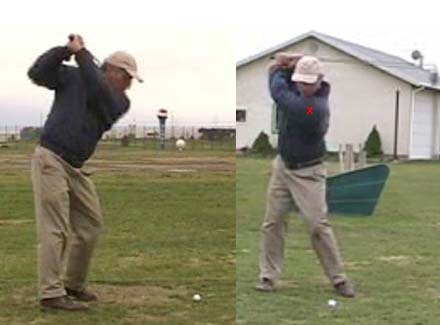 I think that I get an adequate hip turn. However, I cannot get my left arm across my chest and my hands far enough back, so my left arm bends at the elbow and also slides up my chest (off plane) and my hands get too high above my neck causing an across-the-line clubshaft position. I placed a red X to show you where my left humeral head is located. I didn't want to focus on my personal (imperfect) swing. I merely wanted to talk about biomechanical factors that may cause a golfer to choose a reactive pivot swing rather than an active pivot swing. I think that if you consider my test for determining hula hula flexibility, that I am correct to state that I have zero hula hula flexibility - defined as an inability to turn the hips forward in the downswing without immediately feeling the shoulders turn passively due to forces transmitted up the spine. If someone holds my right shoulder back in that test, then I cannot rotate my pelvis forward even 1 inch. Here is another biomechanical factor that I have never seen discussed re: limitations in getting your hands far enough back in the backswing - a limitation being due to left scapula movement limitations rather than an inability to rotate the upper torso. I think that many people regard a shoulder turn as being equivalent to an upper torso turn. However, I think that the left shoulder socket can move >3-4" further than the upper torso turn due to the sliding of the left scapula forward. Here is an example. Anthony Kim http://www.youtube.com/watch?v=oqmejmw-lu4&NR=1 Here is a capture image from that video 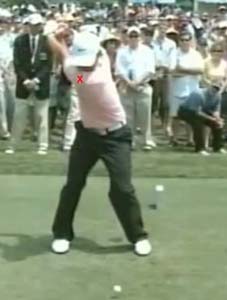 I have placed a red "x" at the location where I think that his left humeral head is situated. Can you see how much he can slide his left scapula forward across his left upper back thus allowing his left shoulder socket to get far more around to the right (compared to me). I personally have far more limitations in left scapula movement than upper torso rotational movements and it is the main reason why I cannot get my left arm/hand far back. Jeff. |
Quote:
Also your arms are getting way lifted off of your chest . . . I mean if you want to get on the turned shoulder plane that's fine but you got some excessive lifting. Feel like you have somebody holding a dowel directly behind you and touching you at the bottom of your neck. Swing the club under that. You'll have to get your hands in and deeper. And your right elbow won't shoot up and off your body as bad. That's a big part of your OTT issue. If your hands are "high" and you spin they shoot over really fast. So you have to slide EARLY and A BUNCH to keep them on the plane. A lot of that has to do with right elbow location. You need to feel like you are swinging in a room with a 6 foot ceiling.    See how right elbow location effects the plane angle? Also to keep the hands from flying out over the plane you have to SLIDE to keep the hands from flying OUT over the plane . . .PLUS you have to release #4 FAST FAST FAST . . . Furyk releases #4 as fast as anybody in the game. Hogan had a really fast release of #4 too . . . but notice that he doesn't have that much range to cover to keep his hands coming down his selected plane. Check Snead's start down . . . he doesn't release #4 as early and shifts it OUT more . . . Then down the plane. |
Here's Hogan vs. Snead . . .
  Snead #4 isn't releasing at the same rate as Hogan nor are his hips going as much forward as Hogan's. Look at where their hands are relative to each other at about the same spot in the motion as they start down . . . hogan's hands are in more and lower (#4 and more hip slide) relative to Snead. |
12PB
Thanks for being helpful, but you do not understand my physical limitations. You seem to be presuming that I simply don't know what to do. You wrote-: "Jeff . . . . I don't know if I get your test deal . . . dude you have plenty of differentiation of the hips shoulders on that backstroke! Just do the same thing on the down stroke??? You don't get it. I can turn my hips back enough and my upper torso enough, but I cannot reverse the process as required. In the downswing, using an active pivot action, the hips need to move first while the shoulders are held back - that creates secondary axis tilt and then the right shoulder can secondarily come downplane (instead of roundhousing). I cannot move my right hip forward in a shift-rotation manner without my right shoulder immediately rotating forward - it is like there is a stiff metal rod going up my spine that attaches my pelvis to my shoulders. If my right pelvis moves 3-6" forward in the downswing then my right shoulder immediately moves 3-6" as well. Any attempt to square my hips at the start of the downswing- like Hogan in his video lesson - causes my right shoulder to move horizontally by about 6-8" in an OTT move. You also wrote-: "Your arms are probably getting blocked from going back up and in because your right hip is in the way." No way! I have no problem moving my right hip back in the backswing and it certainly doesn't prevent my arms from moving correctly. You also wrote-: "Also your arms are getting way lifted off of your chest . . . I mean if you want to get on the turned shoulder plane that's fine but you got some excessive lifting. --- You'll have to get your hands in and deeper. And your right elbow won't shoot up and off your body as bad." I know all that because its is very simple to understand. However, I cannot get my left arm back along a shallow path that allows my hands to get in deeper below my right shoulder - because my left scapula doesn't move, which means that my left shoulder socket doesn't move around enough (despite a relatively good upper torso rotation). I have won many friendly bets from other golfers who have tried to prove me wrong. They have pushed with all their strength on my left shoulder to get it to move more around to the right during my backswing, and they cannot get my left shoulder socket to move around enough despite maximum push-pressure. I could be a millionaire by now if I placed huge money bets on this particular challenge. You are correct that my right elbow shoots off like that because my hands don't get deep enough. However, I cannot avoid the right elbow positional problem because I simply cannot get my hands deep enough. The combination of high hands (near the neck) and a roundhousing right shoulder problem due to a lack of hula hula flexibility is why I cannot use the standard active pivot action. That's the whole point of my thread. Jeff. |
Quote:
So what do you do to compensate? |
12PB
I applaud your persistence in asking probing questions. Getting to the nitty-gritty details can sometimes be very instructive. You seem to be implying that I am capable of good hula hula flexibility in my backswing. That's not true. Consider the facts. Look at Anthony Kim's torso rotation in the backswing. Note that his torso has an even rightwards slope. That is frequently seen in good golfers and it is due to the even spread of rotation over the entire thoracic spine and upper lumbar spine. Each of AK's thoracic and upper lumbar vertebra are capable of about 2-6 degrees of rotational movement. That allows him to spread the rotational load (difference between the degree of thoracic and pelvic rotation) over 12 thoracic vertebra and about 3-4 lumbar vertebra. So, if AK rotates his pelvis 45 degrees and his upper torso 105 degrees, then the 60 degrees of rotational difference can be roughly evenly spread over those 15+ vertebra. I have a very inflexible lumbar and lower thoracic spine which is incapable of any rotation. The only part of my spine that can rotate is my mid-upper thoracic spine. Note that I rotate my pelvis about 50 degrees and my upper torso only about 70+ degrees. That means that I only have 20+ degrees of upper torso rotation. Also, note where the rotation occurs. It only occurs at the level of my mid-upper thorax level. That causes me to have a slight reverse pivot as I try to torque my upper torso against the resistance of a more restricted lower body turn. Also, if you look carefully, I don't really rotate perpendicularly around my spine in the backswing - I tend to lift up in the late backswing as I pull my right shoulder back. You can see that I can get my right shoulder more targetwards than I can get my left shoulder anti-targetwards, and that is part of my lifting maneuver. So, I do not exhibit good hula hula flexibility in the backswing. I can torque my upper torso by about 20-30 degrees because my lower torso is grounded through my "fixed" right knee and my feet. Now consider the downswing. I exhibit far less "apparent" hula hula flexibility in the downswing because my upper torso is ungrounded and free-floating. Therefore, when I torque my pelvis when using an active pivot action, my upper torso (which is free-floating) reacts immediately and also rotates. I am not capable of generating any dynamic X-factor (increased torso-pelvic separation) at the start of the downswing. I have learnt how to deal with this limitation by performing a compensatory action. Knowing that my right shoulder is going to turn immediately when I start my pelvic shift-rotation move, I immediately actively drive my right shoulder downplane even though I haven't yet developed any secondary axis tilt. That means that my shoulders are not turning perpendicularly around my spine. I can do it - but is doesn't feel comfortable. Also, that right shoulder downwards thrust downplane at the very start of the downswing can cause a disruption of my kinetic sequencing, which is not a good thing. That's why I do better with a reactive pivot action. I can throw my hands down-and-out on the plane before my torso reacts, and I am better able to generate a more synchronised, smoother swing action using this type of pivot action. Obviously, a golfer cannot drive the ball as far using a reactive pivot action swing than a pivot action swing. How much loss in distance do you think will occur when using an arm swing versus an active pivot-driven swing in a good golfer? Jeff. |
Quote:
Jeff . . . . I don't think you're talking about Mr. Kelley's Hula Hula . . . let's define terms first . . . . then you can tell me whether you can do Hula Hula or not . . . . 7-14 HIP TURN The Hip Turn as a Stroke Component is strictly the product of the Knee Bend and the Waist Bend. Not otherwise could the weight be shifted and the Shoulder Turn Axis be tilted without moving the Head. A Hula Hula flexibility allows the Hips and Shoulders to be independent but coordinate and so avoid Right Elbow – and – Hip interference and its “Roundhousing” Throwaway (4-D-0) during the Start Down – the Delivery Line ROLL PREPARATION (12-3-22).Can you push your hips forward with out having your head move forward? If not maybe you need to build a stroke that will comply to those limitations. There are plenty of patterns that are very viable. I would start with Circle Delivery as it doesn't require Axis Tilt. To your point of reactive pivot vs. active pivot . . . depends . . . . I think speed can certainly be a factor but how many MPH do you think you are going to give up? It was Mr. Kelley's assertion that Zone 2 is the power zone. Based on what you have put up we can debate your Hula Hula acumen but I don't think we can debate whether or not you have arms :). So I would say that yes the pivot can certainly ramp up speed but if you are going to believe Mr. K the real speed comes from the power package and #2 is the velocity accumulator. Soooooo . . . you know this anyway . . . . I'd say the ball "perfers" being struck solid and square to a bunch of speed that has fleeting alignments. Comparing yourself to Anthony Kim is severe. Kinda like Brad Pitt trying to smoke me in a wing eating contest. Not many people are going to be able to generate the kind of speed he does. So the ball knows speed . . .but also knows face and path and solid contact . . . I'd say if you can't have some kind of mutant level pivot than you better dang sure figure out a way to pivot to maximize hitting the ball solid which is basically controlling low point. So you may not have a Ferrari pivot but you can SWING or DRIVE your arm/arms. Solid and a matching face/path with reasonable speed trumps just pure speed. So the answer to your question is . . . sorta, maybe, yes, no. But I still submit that you have shifted your hips in the backstroke and your axis is tilted to the right . . . . :). |
McDonald Drills!
|
12PB
I only use part of HK's definition of hula hula flexibility. He states-: "A Hula Hula flexibility allows the Hips and Shoulders to be independent but coordinate." I simply think of hula hula flexibility as the ability to rotate your pelvis in the downswing without necessarily rotating your shoulders concurrently in the same direction. Here is a nice practical demonstration of excellent hula hula flexibility where the dancer can move her pelvis in one direction while she moves her upper torso in the opposite direction.  Jeff. |
Quote:
I couldn't get the video? But what exactly does your definition of Hula Hula executed in the this fashion result in? Mr. K is simply "tilting the axis" so the hands can stay on the face of the plane rather than getting drug out and over . . . . Hips control plane of shoulders which control hand path. I'm not sure this independent rotation concept isn't a recipe for a roundhouse . . . . but I would like to hear your reasoning as to the importance of your concept of hula hula. |
12PB
I agree with HK - that the primary benefit of hula hula flexibility is to allow the right shoulder to descend downplane, and controlling the right shoulder's path helps control the hand path so that they can stay on the face of the plane. That wasn't a video - it was simply an animated gif image. Jeff. |
Quote:
Thanks boss. B |
Hula Hula flexibility
I think that the glossary's definition of Axis Tilt is relevant to HK's description of Hula Hula Flexibility.
Axis Tilt: "To change the plane of the Shoulder Turn without moving the Head, the golfer must tilt the shoulder axis by moving the Hips." Note the WITHOUT MOVING THE HEAD! This is a straight on view not a birds eye X Factor deal. An actual Hula dancer can move her hips laterally or rotationally with her head held still. Axis tilt in both directions. Here are two relevant videos. The first from the original Charlie's Angels TV series. (Thats Burner in the back ground in the white safari suit dancing along.) And the second a belly dancer describing the "horizontal figure eight" albeit with a fare degree of double anchor. The figure eight being axis tilt with the right hip back, backing into transition, the move V.J. described. Perhaps we have the making of a new "Macdonald" drill here, Lynn? Continuos figure eights with the knees pointing straight ahead , the shoulders square (but tilting) and the head held still? O.B. http://www.youtube.com/watch?v=-yzuf...eature=related http://www.youtube.com/watch?v=7-i2g...eature=related |
Centrifugal Sequencing
Quote:
I sincerely wish I could interpret the excerpts from your post above as follows . . . "Active" Pivot = Pivot-Controlled Hands. "Reactive" Pivot = Hands-Controlled Pivot. In both cases, the Pivot -- its Motion (7-12) and Action (7-15) -- is the same. The only difference is control. Unfortunately, I don't think that was your intent. From your post, you clearly meant: "Active" Pivot = Pivot leading Hands "Reactive" Pivot = Hands leading Pivot All of which begs the purpose of the Pivot itself: Does the Pivot set up the circular motion of the stroke, and, coincidentally, Transport the Power Package . . . or does it not? Does the rotor of a ceiling fan or heliocopter spin the blades . . . or does it not? Does the body of the ice skater spin the arms . . . or does it not? This argument has nothing to do with Power versus Accuracy. It has everything to do with Sequencing. And once the Body has entered the equation, its Components (Feet, Knees, Hips and Shoulders) must be sequenced within the overall Motion. And that motion is sequenced Body-Arms-Hands -- Zones One-Two-Three -- NOT Hands-Arms-Body (Zones Three-Two-One). :salut: |
Yoda - yes. I definitely meant that the hands lead the pivot when I refer to a reactive pivot swing action.
I know that you strongly believe that the pivot must be the source of the energy/force that secondarily causes the arms to move in a circular motion and that the pivot represents the central torque generator which causes the kinetic sequence to operate in a set sequence - first lower body, then upper body and then the arms (like a figure skater spinning on the ice). That's an active pivot swing, which is the best choice for flexible golfers. However, I still believe that the reactive pivot swing is a viable option for elderly inflexible golfers. Jim Hardy uses the reactive pivot model in his Hardy 2PS model and Leslie King also uses this reactive pivot model in his arm swing model. It has many disadvantages, but it also has many advantages for golfers who cannot pivot correctly due to biomechanical limitations. Jeff. |
Engine and Caboose
Quote:
However inflexible, infirm, elderly or whatever . . . The Body still 'sets' -- at the very least -- and the Arms and Hands 'Deliver'. Not the other way around. :) |
OB Left
The dancer performing the horizontal eight dance certainly has hula hula flexibility. What drill would you recommend for a golfer who has had spinal fusion surgery where all the lumbar vertebra were fused together preventing any rotary movement at the level of each lumbar vertebra? How can that golfer perform an active pivot golf swing that requires a moderate level of hula hula flexibility? Jeff. |
Maui Moments
Quote:
:laughing9 |
Yoda
Could you please expand on these statements-: "The Body still 'sets' -- at the very least -- and the Arms and Hands 'Deliver'." I don't know what you are implying. Also, look at Shawn Clement swinging his arms back-and-forth in this sequence. http://www.youtube.com/watch?v=R_Arw9nzj3s Do you think that the pivot is causing the arms to move, or does he simply swing his arms back-and-forth while his body reacts to the motion of the swinging club? Thanks, Jeff. |
Simply Stated . . .
Quote:
:salut: |
Shawn's Three Swings
Quote:
Regarding Swing #2: The prep for this swing shows exactly what an 'Arms and Hands leading, Body lagging' Stroke looks like. Powerless Throwaway. Ugh! it. Regarding Swing #3: Beware blind golfers. Especially those who want to play for big money . . . on their own course . . . at midnight! :laughing9 |
Jeff . . . . look at this motion . . . it's won major smackers and a couple of majors . . . doesn't get his arm way in or up on the backstroke . . . Can probably beat all but 1% or maybe even 1/10% of the members on this website.
http://www.youtube.com/watch?v=CC4hgHucPY4 notice where his hands are at his top . . . just in of his torso . . . but he really releases #4 and he doesn't do much rotating at all . . . just kinda dippy slides it thru there . . . keeps it pretty much on the elbow plane the whole swing. You can get to his top . . . just take your arms in as much as you can without the left arm breaking down . . . AND TURN YOUR HIPS. Short arm swing = gooooooood. All that elbow releasing stuff is tough to return to the same spot every time. |
Perfect Alignments Within A 'Short' Swing
And check that Left Wrist / Clubshaft Lean at Impact!
:salut: |
| All times are GMT -4. The time now is 02:46 PM. |