
|
I didn't notice that. It's good you warn us against these things.
|
|
|
Quote:
The right hand rolls over the left after impact (not before and not during). Allowing the right hand to overtake the left before impact will always produce clubhead throwaway, with the typical bent left wrist. This is called a swivel impact and HK warned about that. You can't practice or perform a drill on a horizontal plane that intersects the chest because the right elbow is not on plane and the Right Wrist will not overtake the Left Wrist after impact. At Impact the Right Elbow is Bent. At full extension the right elbow is straight and will "Cause" the right hand to overtake the left (on an inclined plane). |
Quote:
|
|
|
|
|
Quote:
Homer Kelley claimed that the Pivot and arm swing square the clubface for impact without any need for torque. So true. But this video misunderstands that the shaft is laid off. Actually, the right forearm is re-aligning to the elbow plane for impact. It "looks" laid off because the club and forearm are above plane. This is classic "Right Forearm Angle of Approach" which illustrates that the right forearm/wrist should not rotate during the stroke. |
|
|
Daryl: I have read this: Homer said it's pivot torque that releases the club for Swinger's and torque applied to the lever assemblies that does it for Hitters. It's hinge action...zone 3!the hands that squares the club or otherwise manipulates it differently through impact.
In case you want to the read the whole post this is taken from: http://jeffygolf.com/showthread.php?...s-stuff-happen Additional note: My source says: "my apology, it seems the word "torque" doesn't appear in TGM. This seems odd to me as it's my understanding torque is necessary to initiate a circular motion. What I was referring to is what he calls Pivot Thrust, not pivot torque, but I can't see how you can have thrust without torque in a rotating system. Help anyone? Maybe torque initiates the pivot's work but then the motion continues on its own as in a flywheel. I can see that for Swingers. With hitters the right arm thrust initiates the lever assembly's rotating motion, which, again, continues with no torque added. Maybe this is what is meant by a "freewheeling release."" |
|
Quote:
"Casting" is applying Torque. Dragging the Club and sensing Clubhead inertia through the #3 Pressure Point is not the same thing. We are not trying to move the Clubhead by adding pressure to one end of the shaft to move the other end of the shaft. Neither does a Hitter who uses the #1 Accumulator to Drive the Primary Lever. When these guys use the term "Torque", be careful of their meaning. Some use the term to describe the "Flip Release" and the Flip Release can be an application of Torque. It can also produce Clubhead throwaway. The Flip Release is used by 95% of all touring Pro's who, for the most part, properly compensate for "Throw-away". But any application of Torque leads to a "Counter-Rotation" (Clockwise) of the "Clubface" (Leading edge/Top Edge) into the Impact Interval. I don't expect you to understand this yet, but sustaining a Line of Compression requires a dual rotation through the Impact interval (two counterclockwise rotations). The guy in the video was referring to not having to rotate (Counter-clockwise) the right wrist to square the club-face for impact but rather use body rotation and arm swing. This is "Classic" Homer Kelley. The reason I was so excited about seeing the video, is because here's a Bio-Mechanic guy who seems to know very little about the geometry of the Golf Swing, discovering that Body Rotation and Arm Swing alone, passively Square the Clubface. This is a giant leap in discovery/knowledge for him. This guy is a thinker. Great discovery. And he didn't have to spend 30 years studying the Golfing Machine. |
The way I explain McKenzie's results in every terms is that as the club is set (at transition) under the plane where the hands will move, the dragging from the hand will tend to move it back to the plane. This produces the supination of the left forearm and, if everything is time perfectly, the squaring of the clubface.
It's a nice result but from a model of the golfer/golfswing that is still simplistic in a way. We have the compute power to deal with more realistic models but this needs of course people to figure out the models. It would also be nice to check from the model how much margin of error there is in relying on a pure passive squaring of the face. |
Quote:
In "Golfing Machine" terms, you're describing the "Flip Release" on the Elbow Plane. At the End of the Backstroke, when using a Shoulder Turn Takeaway, the Right Forearm has "Rotated". This results in the Right Forearm Flying Wedge being woefully misaligned to its Impact Alignment. Now, imagine the Elbow Plane. At the End of the Backstroke, the Hands are well above the Plane. Somehow, the Hands must get down to the Elbow Plane for Impact. Now imagine Sergio Garcia. At the End of his Backstroke, everything looks seemingly perfect. But, as he transitions to the Downstroke, his Right Forearm (look at his right Wrist), remains "Rotated". So his Right Forearm looks kind of parallel to the ground while his Clubshaft is almost vertical (on-plane and perpendicular to the base line). To most everyone, this looks normal because the Clubshaft is perfectly On-Plane. But the Clubshaft is not aligned to the Right Forearm. He must (compensation) "counter-rotate" (Clock-wise rotation) the Right Wrist so that the "Right Forearm Wedge" is On-Plane at Impact (Flip Release). When you use the Elbow Plane, its very apparent, as you have pointed out, that the Right Forearm Wedge alignment is NOT in-line with its movement-direction (path). But this is how the Right Forearm Wedge operates. If it were in-line with its path, it would be "Right Arm Swinging". It is true that "Dragging the Handle" will cause the Clubhead to get in-line (from being off-plane) with the Hand Path. But this also causes the "Counter-rotation" and re-aligns the Right Forearm Wedge for Impact. Dragging does not cause Release (the Pulley). The problem is perception. If this occurs "early", at Transition, it appears that the Club was laid-off. If it occurs "Late", you think that Dragging the Club has Rotated (counter-clockwise) the Left Arm. Actually, its the Right Forearm Wedge that rotated the Left Arm. This total concept stems from the Right Wrist Rotation at the End of the Backstroke, caused by the Shoulder Turn Takeaway. If this model is considered "normal" and is used to examine the Golf Stroke, keep in mind that you are examining a compensation. All of this lead McKenzie to "Think" of "passive rotation". That's a giant leap. He ended up at the right place while going the wrong way. If he continues this research I think that he'll discover that the Pivot Rotation and Arm Motion truly square the clubface for impact without any need to apply torque to the Clubshaft. |
From my source:
"This is interesting. I was referring to the initial torque that starts the body's pivot that sets the whole swing in a circular motion. But as I corrected myself, Mr. Kelley refers to this as Pivot Thrust not Pivot torque. It remains a mystery to me why in a system based on the physics of rotation and torque is required to initiate circular motion why the word torque doesn't appear in TGM. Perhaps your friend would like to offer an explanation." |
More work for Daryl: "Air , your friend mentions right forearm torque . Ask him if the left forearm can torque while the right doesn't ( passively or actively ). And does this assume a 10-2-D grip if the answer is yes"
|
|
Quote:
|
More
"I see. Can you ask him if it is because torque is a measurement of a force and not the force itself that it is not mentioned in TGM? And thank him for me for the help."
|
Quote:
The #3 Accumulator and Pressure Point will Roll the Left Arm while simultaneously keeping the Left Shoulder at the Center. Roll power of the Right Elbow. This is "Hinge Action". Any attempt to square the Clubface by applying Left arm rotational force will cause a Swiveled Impact. This not only results in compression leakage but alignment issues as well. This is the hard way to play Golf. The guy that you're talking to is a #2PP swinger. He's having a difficult time understanding how the Left Arm Rotates. I know this because he's asking about the 10-2-D Grip. The 10-2-D doesn't need much Left Arm Rotation and is often adopted by players who don't understand how the Pivot and Right Forearm Rotates the Left Arm. If he wants to use a Standard 10-2-B Grip he needs the Right Forearm Angle of Approach and #3 Accumulator Roll. Tell him that at Impact, His Right Forearm, although its pointed downward, must also almost be Pointing at the Target (On-plane, which is almost parallel to the Base line of the Plane). This needs a Pivot with a great amount of Rotation.. Like Greg McHatton likes to say, "it's not how fast, but how far". |
|
Air, let me clarify for your friend.
The Right Forearm should not Rotate as though you were using a screw-driver to remove a screw but the Left Arm will. You remove the screw (counter-clockwise rotation) with the Left Arm but only when and as much as the Right Elbow Straightens (Release Swivel). This is "Roll Power" of the #3 Accumulator. At Impact, the back of the Left Wrist will face the Target but the inside of the Right Wrist will be facing "Upwards". Watch a dozen slow-mo video's of the Pro's, down the line and face-on. Watch the inside of the right wrist. |
Quote:
Watch his right forearm travel from release to impact without any longitudinal rotation of the right forearm to square the face. |
Quote:
|
B.J. Hathaway,
|
Quote:
|
Basic understanding of TGM doesn't sound too bad. What does it take to be good enough?
|
|
Quote:
Concepts Geometry of the Circle Hinge Action Right Forearm Angle of Approach Plane Line Tracing Acceleration Sequence etc. The 24 components are basic understanding but I really believe that you don't fully understand or appreciate them without knowledge of the theories. |
I have a long way to go, so every time you explain something, it helps. Looking forward to your videos.
|
|
|
Daryl: Could you explain for me the underlying fundamentals of the Line of Compression?
|
Quote:
We strike the ball with the force and Strike-Plate square to the Angle of Approach. Then, we use a Hinge Action to:
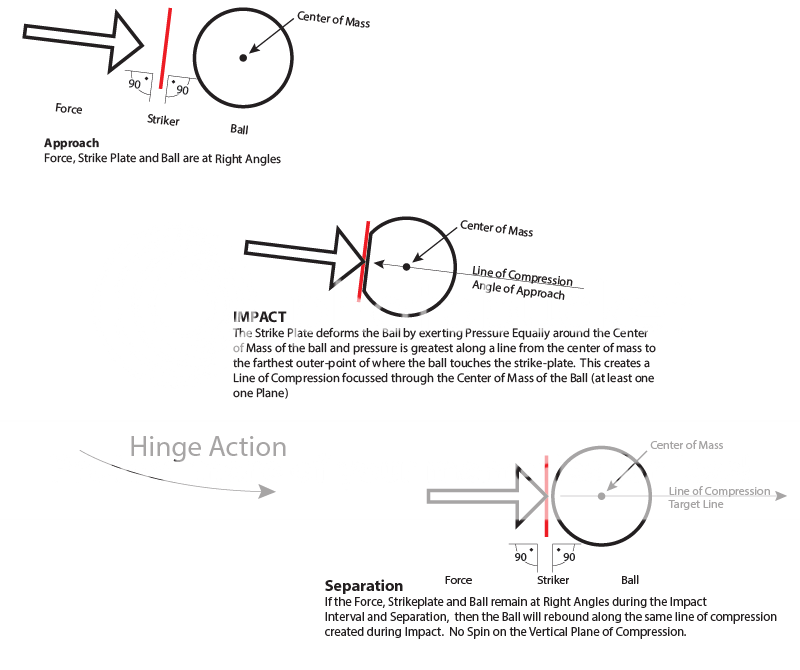 Another way to understand the Concept of Line of Compression. If we drop a Ball, then a Force (Gravity) will pull the ball into the Strike-Plate (Sidewalk). If the Strike-plate is square to the force (if the sidewalk is level), during Impact, pressure against the ball will be equally applied around the center of Mass of the ball. When the Pressure against the ball is greater than the force that deformed the ball, then the Ball will rebound away from the Strike-Plate. If the Strike-Plate, Ball and Force remained at right Angles, then the Ball will rebound along the same line of compression created from Impact. If you Swivel the Right Wrist Through Impact, then a Straight Line of Compression cannot be created, maintained or manipulated to Align to the Target. More knowledge: The Ball is stationary. The Clubface moves into the ball. The Ball will move as soon as it offers greater resistance than the pressure it receives from the clubface force. By the time the ball has moved 1/1000 of an inch, it is moving at the same speed as the Clubface. From the balls point of view, at this point, the Clubface is a stationary object. The Ball puts pressure on the Clubface during rebound. If the shaft isn't pre-stressed or stiff enough for the swing speed, some of the balls compression will wasted in pushing back the clubface during its rebound escape. A #2 Pressure Point Swinger focuses on Approach Speed while the #3 Pressure Point Swinger has his attention on Separation Speed and uses the #3 Pressure Point to pre-stress the clubshaft to reduce rebound compression loss. |
Quote:
|
Thanks for your LOC information.
What do you have against Shawn Clement's instruction? |
swiveling ......
|
| All times are GMT -4. The time now is 04:14 AM. |